Showing posts with label Best Writing. Show all posts

Tuesday, September 22, 2020

None Shall Escape (1944)


Alexander Knox, a great actor all but forgotten by history, gave inarguably his two greatest performances in 1944. In a way it’s a shame — he was nominated for Best Actor as the title character of one of 1944’s heavyweight contenders, Wilson. Had that picture, which earned a robust five Academy Award nominations come out in any other year, or vice-versa, he may have also been nominated for his chilling performance in None Shall Escape. Wilson was released to videocassette in a limited fashion a generation ago, while None Shall Escape was finally released on blu-ray in 2019. The marketing approach of Escape’s poster suggests that Columbia was unsure what to do with it, which isn’t surprising given the film’s concept and lack of a major star. Considering the ensemble cast, Knox could have garnered a Supporting Actor nomination — despite clearly being the film’s star.

None Shall Escape is a difficult film to write about. It’s one of those pictures about which there is simply too much to say; there are too many angles of approach, too many lenses through which to view it. If nothing else, it’s a film that simply must have an engaging production story. Director André De Toth was obviously close to the project — born in Hungary, De Toth came up through the ranks of the central European film industry, and even filmed the German invasion of Poland in 1939 as a news production cameraman. He was a Hollywood emigré when this was filmed, but the results have a certain veneer that belies both De Toth’s youth and the film’s meager budget. Escape received a nomination in the Original Story category for writers Alfred Neumann and Joe Than, though James Steffen over at TCM relates that De Toth brought in future Hollywood Ten member Lester Cole to doctor the script.

The film’s premise is a little complicated. Released while the outcome of the war was still in doubt, and told through a series of flashbacks, it is nevertheless set in the future — and a very prescient one: the Allies have prevailed and form tribunals to hold the Nazis accountable. The narrative revolves around the aptly named Wilhelm Grimm (Knox), a German who teaches school in a small village in Poland. As the film opens, Grimm is being put on trial for his actions during the war; a parade of eyewitnesses are brought to testify against him, including his brother and ex-fiancé; the story is told through their recollections.

When the First World War comes, Grimm enlists in the German army but returns from the fighting grievously injured, having lost his right leg along with the better part of his soul. Embittered, he begins to see the world in a different light, and in time becomes infatuated with Nazism. Shunned by his fiancé, he commits a crime that results in the death of one of his pupils and the loss of his own left eye! A harried Grimm begs the help of the local clergy, including the village rabbi, in order to escape Poland. He heads for Munich, where he moves in with his bookish older brother and officially joins the Nazis. He quickly rises in the party, and what little humanity he had left is given over to Hitler. When his brother chooses to flee Germany for Austria, Wilhelm has him arrested and sent to a concentration camp. To add insult to injury, Wilhelm takes over the education of his nephew, and tries to create a Nazi officer in his own image. In the wake of the Blitzkreig, Grimm returns to his Polish village — this time as an SS commander — with predictable results.

None Shall Escape is mind-boggling in its accuracy. The film is so on the money that it’s actually hard to believe it wasn’t made ten years after the end of the fighting. Although it has many uncomfortable scenes, most of them are the result of things said by Grimm. One however, is quite simply astonishing: as the Nazis round up jews to be taken to forced-labor camps, the town rabbi (a man who previously helped Grimm flee the country) asks to address his congregation, being shoved onto cattle cars. Grimm consents, in hopes of quieting the scene, but is shocked when the rabbi tells his people that they are being taken to their deaths, and encourages them to stand instead, and fight. What comes next is surprising, but not in the way you might expect. It isn’t shocking that Grimm orders his troops to machine gun the jews — it’s shocking how graphic the scenes is — De Toth even shows bullets slamming into the bodies of already slumping children. At the conclusion of the scene, the rabbi staggers to confront Grimm, who at first appears to rush over to embrace the man, but instead casually draws his pistol and shoots him in the chest.

I could write many, many more words about None Shall Escape, but I don’t want to give away anymore about the story than I already have; and I hold no illusions that I could maintain interest if I did so (but I’ll reserve the right to revisit this one on the occasion of another viewing). If nothing else it’s an absolutely superior B film with a stellar performance from Alexander Knox.

None Shall Escape (1944)
Directed by André De Toth
Starring Alexander Knox
Released by Columbia Pictures
Running time: 85 minutes
Availability: Bluray as of 2019. Has aired on TCM, bootlegs.

Grade: A

Sunday, August 25, 2019

The Eddie Duchin Story (1956)

Stephen King gave an interview once where he was foolishly challenged with a question about literary history. I don’t know why, but journalists always think they can show up popular authors by exposing them on literature knowledge — this one oddly asked the former English teacher if he had ever “read the classics.” It was like some poor sap trying to heckle Don Rickles. King, like nearly every other best-seller out there, not only knows his business but is usually slicker than the person asking the questions. I’ve always loved his glib response, which went something like: “I don’t know anything about William Faulkner, but I’ve read everything Dean Koontz ever wrote.”

I recently had a similar moment chatting on a Facebook message board when someone accused me of not knowing anything about “film” because I’m not a David Lynch fan. For example: “If you knew anything about surrealism you might begin to understand and appreciate Lynch’s films.” Instead of taking the easy way out, as Stephen King could have done, and sharing that in real life I’m in the chair of a university department of art and art history, I took a page out of King’s book and shot back, “I may not know anything about surrealism, but I’ve seen every picture Tyrone Power ever made.”

That was almost true — I had somehow missed this one; which you can file neatly in the forgotten gems category. Like most other musical biopics, Columbia’s 1956 film The Eddie Duchin Story relates the life events of yet another mid-century musical personality. Aside from a relatively early Kim Novak performance there’s little about the film that would really pull in contemporary audiences, which is a shame. After all, Duchin’s name is all but forgotten these days — as he wasn’t a composer or lyricist none of his tunes became standards, and his untimely death in 1951 didn’t contribute to his longevity. The Eddie Duchin Story isn’t an MGM picture either — coming instead from Harry Cohn and major-minor Columbia, not a studio well known for musicals that didn’t feature Rita Hayworth. Still though, stars and studios aside Duchin’s story is great film fodder; and the resulting movie is a fine romance and a tear-jerker of the first order.

Tyrone Power and Kim Novak are a strange match — a generation apart, Power exists in the mind as a primarily a black and white film actor while Novak is pure Technicolor. He on the tail end of a robust career and she at the beginning of one too short. Opinions differ concerning Novak’s strengths and weaknesses, but who doesn’t wish she made more films? This one cleverly handles the delicate issue of the billing: Power above Novak, same size type on the printed materials; but Novak first in the film’s titles, with Power getting a special “Starring Tyrone Power as Eddie Duchin” screen to himself just after director George Sidney’s. Although Power was nearly twenty years Novak’s senior, her character was actually supposed to be a little older than his. The film tries to split the difference, clumsily hiding Power’s age in the early scenes, and making Kim look a bit dowdier than necessary.

Power was 41 when this was made, so it seems a bit strange that he would be cast in the first place, however all concerns evaporate when he sits down at the piano. Duchin’s trademark as a pianist was the speed and complexity of his fingering, and Power is certainly up to the challenge. Sidney and cameraman Harry Stradling (he of 14 Oscar nominations, Eddy Duchin included — and 2 wins) go out of their way to ensure the viewer knows that the hands on the keyboard belong to the star — and if Power is somehow faking Duchin’s virtuosity then he deserved an award for it. All of the musical scenes are well done, and any inclination viewers might want to hit the fast-forward button during the musical bits (Can anyone say Funny Lady?) is lost here. The film is beautifully photographed and makes New York City look stunning. A pseudo-montage that takes place when Power and Novak are courting is particularly beautiful, and takes full advantage of Novak’s spectacular rapport with the camera.

Surprisingly, Novak’s part is short given her billing; and there’s a great deal more to the story than has been mentioned here. As I wrote earlier this is both a romantic film and a tear-jerker, with the emotional scenes coming on heavy as the film approaches the two hour mark. There’s one moment in particular — a small one — where a uniformed Power happens upon a burnt up piano in a wrecked bar on Mindanao. It’s a brief but important scene, and certain to bring a smile to your face — for me it made the picture. In the end, this is a movie about more than just those loved and lost. It’s concerned greatly with familial relationships and the ties that bind fathers to their sons. It looks good, it sounds good, and it entertains. What’s not to like?

The Eddie Duchin Story (1956)
Grade: B
Directed by George Sidney
Released by Columbia Pictures
Starring Tyrone Power, Kim Novak, and James Whitmore
Running time: 121 minutes
Availability: DVD, Netflix

Saturday, October 27, 2012

The Leatherneck (1929)


1929’s The Leatherneck must have been perfect matinee fare for depression era boys looking to escape for an hour or so into the far-flung adventures of the United States Marine Corps. The film is brief, straightforward, and uncomplicated—with a healthy dose of buddy humor, fisticuffs, and male bonding. It was clearly intended for the raucous appetites of young men with a developing sense of bravado, and hints at the military camaraderie of later films such as Gunga Din and The Lost Patrol.

Through a series of flashbacks, The Leatherneck tells the story of the court martial of a wrongly accused Marine. It stars William “Bill” Boyd as Tex, who in the days immediately following the armistice has been saddled with the unenviable task of guard duty. (As Hopalong Cassidy, Boyd would go on to be a pop culture icon of the 1930s and the 1940s, and a TV icon of the 1950s) He strikes up a fast friendship with one of the stockaded Germans, Otto “Fuzzy” Schmidt (Alan Hale), with whom he shares a love of beer and brawling. Moments after the film’s beginning the duo becomes a trio as Private Hanlon (Robert Armstrong, Carl Denham from King Kong) joins their ranks. Owing to these newfound friendships, Fuzzy decides to become an American citizen — as well as a Marine — and is soon reunited with his pals when their unit is transferred to politically tumultuous Russia. There Tex falls in love with and quickly marries Tanya (Diane Ellis), a local girl whose aristocratic father owns a Manchurian potassium mine. However “Captain” Heckla, an American opportunist (war profiteer, if you like), steals the mine by arranging for Tanya’s father and brother to be murdered by the Bolsheviks. Heckla then kidnaps Tanya and absconds with her to the mine, leaving the marines to think Tanya shared the same fate as her family. But when Fuzzy and Hanlon learn that Heckla is running the potassium mine, they suspect that Tanya is still alive and abandon their posts in order to investigate. Tex follows, and when he arrives at the mine he discovers that Hanlon has been shot, Fuzzy has been tortured, and Tanya is nowhere to be found. They attempt to return to their unit, but Hanlon dies en route, and Fuzzy is barely functional after days and days of torture. Tex is charged not only with desertion, but also with Hanlon’s murder, and is placed on trial for his life. While Tex’s life hangs in the balance, the audience asks: Where is Tanya?

This is an entertaining light adventure film, though it works better as a buddy picture than it does as an exposé of life in the Corps. Beyond the firing line sequence described below, there are no spectacular set pieces or long action scenes, but the performances more than make up for any deficiencies. Boyd, Hale, and Armstrong have great chemistry, using broad physical acting to compensate for the film’s lack of dialogue. Diane Ellis offers little as the picture’s sole female, but she gives Boyd the chance to wax romantic and makes the show worthwhile for the young ladies that may have found their way into the theater. In addition to the three leads, Fred Kohler stands out as a sufficiently dastardly Heckla. (He should be recognizable to crime film buffs for supporting roles in two of the period’s groundbreaking films: Underworld and Thunderbolt.)

The Leatherneck’s best scene, in which Tanya’s father and brother are executed, is out of character with the rest of the film: it was likely inserted to give wide-eyed audiences a sense of the violence of the Soviet revolution, and is striking in its expressionism: rather than seeing the men themselves riddled with bullets, the camera goes shot-reverse shot between the victims and the sneering machine gun crew as it pans across a wall of shadows, starkly rendering each shadow as it spasms and crumbles to the ground. This is quite a rare film, even considering its Academy Award nomination in the Writing category. While it doesn’t rise to the same level as another of Bill Boyd’s military silents, Two Arabian Knights, it’s still worth seeking out.

~~~ 
Before I close, a few words about The Leatherneck’s director, Howard Higgin, who died too young at age 47. In spite of his brief career Higgin was an important filmmaker during the transition years at the end of the silent era. He got his start working as a production manager in the late teens and early twenties for Cecil B. DeMille, shadowing the great director on his light comedies and dramas starring Gloria Swanson — a few also featured a young William Boyd. Higgin was directing by 1923, and would helm more than twenty films before his death in 1938 — he’d serve as screenwriter on another twenty more. If nothing else he was a Welles-ian trouper, employing the same actors over and over again. Boyd starred in five of his directorial efforts, including Clark Gable’s breakout film The Painted Desert, High Voltage with Carol Lombard (they too worked together often), and Skyscraper with Leatherneck cast member Alan Hale. Hale also worked with Higgin and Fred Kohler on the delightful and utterly unseen Sal of Singapore, which I look at in depth at Where Danger Lives.

Higgin’s films did well at the box office, and were well thought of by critics and the academy. Three of his features (The Leatherneck, Sal of Singapore, and Skyscraper), each written by Elliot J. Clawson, were nominated in the 1930 Best Writing category. Clawson was also nominated for a fourth film in the same category that year, The Cop, which although not directed by Higgin, amazingly starred William Boyd, Alan Hale, and Robert Armstrong! Truly, Hollywood was a small town.

Final note: Many of these films, including The Painted Desert, High Voltage, The Racketeer, and others are available to watch for free at the Internet Archive. Simply connect via IMDb.

The Leatherneck (1929)
Directed by Howard Higgin
Starring William “Bill” Boyd, Alan Hale, and Robert Armstrong
Released by Pathé Exchange
Running time: 65 min. (IMDb), 56 min. (my copy)
Grade: B

Sunday, February 19, 2012

Last Year at Marienbad (1961)


Alain Resnais’s tedious, beautiful, and silly Last Year at Marienbad is almost more interesting to read about than it is to view, the reactions are so wildly varied. Since its 1961 release it has become one of the more polarizing films ever made, on zillions of best-of-all-time lists and as many worst-of-all-time lists, while almost everyone considers it indecipherable. This isn’t a movie for those interested in Hollywood-style entertainment, so the majority would just look baffled.

Surreal? Not really. As an art professor I can tell you that the word surreal gets bandied about a little too often, particularly by film people.  I’ll also add, with some oomph behind it, that when confronted with indecipherable our typical response is either “bullshit,” or “chickenshit.” (By the way, “art” is a praise word; you don’t call yourself an artist or label your “stuff” art, let others say such things about you or your work. Of course don’t mind me, you can do so if you like.)  Dreamlike maybe? Okay, whatever. If nothing else the film offers one more filmic take on the dream state, however elementary, and not meant to be deciphered, not meant to be understood, and especially not meant to be responded to. It seems to have vomited itself up, as if a Psych 101 study group made a list of all of the different things that happen in dreams, and then tied the experiences together with film and fishing line and called it a narrative: that of a man attempting to convince a woman that they shared an affair in another time and another place — perhaps last year, at Marienbad. She resists, and the bulk of the running time is ostensibly concerned with his fleshing out of this elaborate fantasy, though it’s really just an excuse to stray into pure formalism and call it art, with the hope that the pastiche of imagery will be enough to hold one’s attention for the duration. Look for something authentic or question the thing, or express any misgivings at all and you run the risk of appearing oafish or uncool. (and it’s amazing to consider this film has held such power over audiences, and repelled criticism for more than fifty years now. I won’t even begin to attempt to fathom its Oscar nomination in the screenplay category.) Yet it remains that this is movie, or rather film (movies tell stories) is too vain, too obviously collaborative, and too damn superficial — and it appeals to those qualities in its viewers. Have you heard it before? Too much style, not enough substance. This ain’t artsy folks, it’s banal. Why do you think it’s so popular? 

If you want to read the film as an examination of dreams, or even the fleeting nature of memory, go ahead — you get 93 minutes to wallow in it. Marienbad is a visually striking film that despite all of its formal decadence refuses to function as a drama. It cannot pass muster merely through the power of the still image — the difference between the still photograph and the film is one of duration, and so the presentation of a succession of striking vignettes, either wholly disconnected or connected with a wink and a smile, does not add up to a worthy cinematic experience, at least not for me. If so, it’s a lazy one. As such, film is inherently inferior to the traditional arts. If viewers are supposed to be enthralled by the cinematic experience and the means by which it unfolds then let’s find better subject matter. Call me bourgeois, but I care little for Resnais’s beautiful people and their vapid dreams. After all, if these characters are people I’d hold up for scorn in waking life, then how in the world can I love a film that explores their dreams? On the merits of the formal qualities alone? Maybe — the technical filmmaking here is masterful, but that just isn’t enough for me. By the end of the first hour I was squirming at the redundancy of the dialogue, the repetition of imagery, and even the grotesque artificiality (how often can she pose?) of Delphine Seyrig. Tedious.

In the end, Marienbad has as much power as the advertisements for Chanel No. 5 it inspired. 

Last Year at Marienbad (1961)
Directed by Alain Resnais
Starring Delphine Seyrig and Giorgio Albertazzi
Running time: 94 minutes
Grade D

Wednesday, December 14, 2011

The Valiant (1929)

Thanks to TCM’s daylong celebration of the preservation efforts of the George Eastman House, I was able to view Paul Muni’s first film effort, The Valiant, directed by William K. Howard and released by Fox in 1929. The film would earn the Austrian born, New York bred Muni the first of his six Academy Award nominations, each and every one in the Best Actor category. He’d lose the second-ever Best Actor statuette to colossal movie star Warner Baxter (In Old Arizona), but Muni’s time in the sun was coming: he would be nominated four times between 1934 and 1938, winning the award in 1937 for his portrayal of Louis Pasteur. (Muni bookended nicely: his last nomination came in 1960, in his final film, The Last Angry Man.) Along with his rival at Warner Brothers, Edward G. Robinson, Muni dominated screens in the thirties — his star exploding after title roles in a pair of 1932 films, Scarface, and the astonishing I Am a Fugitive from a Chain Gang. All but forgotten by contemporary audiences, Muni was an actor’s actor and one of the biggest stars in the world. He was a chameleon, able to transform himself into whatever his role called for, whether it was suave gentility or brute physicality, regardless of age or nationality, and he could do any accent required — though he famously told Irving Thalberg that he was “about as Chinese as Herbert Hoover” when the boy wonder cast him in The Good Earth.


The Valiant opens auspiciously: Muni shoots an unseen man in some drab big city flat and wanders out onto the street, and eventually into the local precinct, where he confesses. In short order he’s thrown behind bars, tried, and sentenced to die in the electric chair at Sing Sing — a rapid-fire chain of events that Muni takes in stride. He seems resigned to his fate in moralistic, Old Testament sort of way. He tells his captors his victim deserved to die, and that he realizes that he too must be punished in accordance with the law.

The dramatic thrust of the film lies not in the identity of the victim or the motive for the crime, but in the real name of the killer himself, which Muni stubbornly refuses to divulge. Instead, he assembles the moniker “James Dyke” from a police station wall calendar. (The earliest instance of this particular film cliché I’m aware of.) Cut to the prison, where we learn that not only is Dyke a model inmate, but that his sensational case has even provided him the opportunity to write moralizing newspaper editorials, making his story and face known to a fascinated nation. In Ohio, the elderly Mrs. Douglas sees the condemned man in the paper and wonders if he could be her son Joe, gone without a trace these fifteen years. Her daughter Mary and Mary’s fiancé Robert (the popular Johnny Mack Brown) make the trip to New York in an effort to learn the truth, but although the film makes it abundantly clear to the audience that James Dyke certainly is Joe Douglas, Joe is able to convince the desperate young woman that he is not the loving older brother who used to read Romeo and Juliet to her when she was a little girl. Instead, in the sort of turn that could only happen in an early Hollywood tearjerker, “Dyke” claims to have known a man named Joe Douglas during the war, and to have seen the youth die heroically in the trenches. I’ll call it quits after this in order to spare as much of the ending as possible — Mary is then able to leave the prison with her chin up, believing that her brother died a hero and now able to return home to marry free and clear of any potential scandal.

This is an engaging movie, and thankfully it’s short enough (only 66 minutes) that one can get through it without ever feeling taxed. First is Muni: the abilities that would see him become the preeminent dramatic actor of the thirties are evident; he’s simply light years ahead of everyone else in the film in terms of ability and intuiting the medium. More than that though, Muni has that intangible something, the charisma, the screen presence, the “it” that has characterized actors such as Cagney, Dean, and De Niro throughout film history. The Valiant is a rudimentary early talkie, but Muni owns the thing.

Speaking of which, the film is notable for its technical accomplishment. While the cameras are static (there are a few close-ups), and the sets are theatrical, there are some fine “special effects” shots that appear during various flashback sequences, when a young Muni is superimposed over a medium shot of the character (usually his Whistler’s Mother-like ma) doing the remembering. And although it boasts no musical score, the sound in the Eastman print is crisp and clean, with all of the spoken dialogue easily understood. Part of that owes to the simplicity of the Oscar-nominated writing itself: a great many of the Fox theaters chains were rural (compared to those of Paramount and MGM), and consequently numerous Fox features were targeted at the uneducated or the unsophisticated, who nevertheless frequented American movie houses in droves. All of the characters deliver their lines deliberately, and with no small amount of silent-era pantomime, but it’s also apparent that the writing itself was been simplified in order to facilitate easy understanding. The narrative moral of the movie — and even its title — speak directly to rural audiences about the corruption of city life. A good mid-western boy was called to the war, and at its end was lured to the city instead of back to his home — and there he was obliged to do murder. Audiences are warned that even a young man worthy of the film’s title, The Valiant can still be ruined by the perils of the city, and that in forsaking his home and his family, he has sufficiently challenged the fates to destroy him.  

The Valiant (1929)
Directed by William K. Howard
Starring Paul Muni
Released by Fox Film Corporation (20th Century Fox) 
Running time: 66 minutes
Availability: Just aired on TCM, previously quite rare. Poor quality copies on ioffer.com. 
Grade: B, historically significant. 

Tuesday, December 6, 2011

The Organizer (1963)


Prolific filmmaker Mario Monicelli’s 1963 masterpiece I Compagni, or The Organizer tells the story of textile mill workers in late-nineteenth century Torino who find the strength to protest working conditions thanks to the intervention of an itinerant, mild-mannered (and of course, bespectacled) intellectual vividly realized by Marcello Mastroianni. It’s a thoughtful and beautiful movie, as insightful as you might expect and funnier than the subject matter would suggest. Who’s to say whether or not The Organizer has been forgotten — though it is undeniably rare: only 420 IMDb votes, and not one professional review (though IMDb does link to a superior long essay on the film by the wonderful Marilyn Ferdinand, here). It’s a shame, this is a film certain to please a broad constituency, whether fans of the principals, the Oscars (Best Original Screenplay nominee, 1965), foreign fare, labor movies, or merely great cinematography. It’s a serious film about a serious subject, and like real life itself, it moves smoothly (or awkwardly — depending on your point of view) from tragedy to comedy, brimming with the sort of humanity and struggle that transcends language. This is one of Mastroianni’s most subtle performances, and possibly his best. He punctuates his meekness and restraint with moments of pure charisma and wild abandon, and creates something very memorable.

One note: the poster depicted here is a stinker — Matroianni sports a beard and glasses throughout, and The Organizer is hardly a sexual film, as the poster suggests. 

I’m want to keep my thoughts here very brief, but I did find one sequence in particular to be emblematic of the character of the entire film, demonstrating the novel way in which The Organizer manages to heartbreaking, funny, and endearing all at the same time. Monicelli’s deft blending of irony, humor, and tragedy coalesce perfectly in this sequence, involving a Sicilian, Salvatore Mustafah, who informs the strike committee that he intends to cross the picket line. “What are you?” the committee members ask from their second-story balcony. “A desperate man,” he shouts up from the dirt piazza below. Owing to his recent arrival in Torino, Salvatore is unable to secure a line of credit at the company store and consequently must work. However he doesn’t want to be disrespectful to the strikers so he respectfully informs them of his intentions. Their response is to beat some sense into him, but when they arrive at the little man’s place and quite literally knock the “door” down, they are so appalled by his meager living conditions that they immediately relent and grant him permission to return to the mill. He does so, but the bosses rebuff him and try to toss him back out onto the street, even going so far as to strike him. The enraged little Sicilian then whips out his switchblade (the one filmdom has taught us all Sicilians have at the ready), but alas, it won’t open. In one of the movie’s funniest moments, Salvatore throws the knife to the floor and stomps on it until the catch finally disengages and the blade pops free. But by then, he’s standing alone and the guards are on their way. Monicelli makes the moment intentionally funny, and we laugh whole-heartedly — until moments later when we see Salvatore frog-marched out of the mill in handcuffs, bound for jail and robbed of what little dignity he had left, and we realize that the poorest of the poor always gets the short end of the stick, and that the man with the greatest need, who risks the most, often fares the worst — and that we are laughing at him. But in the end the film is full of such moments, and we understand that Monicelli is neither manipulating us nor is he being cruel. He’s merely reminding his audience that there are times in life where we have to find the humor in the bleakest of situations, lest we give into despair.

The Organizer is very hard to find, but it will reward those who know how to look. 

Monday, March 28, 2011

Rasputin and the Empress (1933)

Hollywood was in many ways still a small town in the early thirties, and as far as motion picture making goes, it certainly operated by a different set of rules. In 1932, Metro’s production chief Irving Thalberg, with “More Stars Than There Are In Heaven” at his disposal, had brought to the screen the first star-studded event picture. Grand Hotel was a critical and financial success for Hollywood’s biggest studio, and featured many of MGM’s top stars, from Greta Garbo and Joan Crawford to Wallace Beery and the Barrymore brothers, John and Lionel. The movie made buckets of money for Thalberg and Louis B. Mayer, and it also captured the fifth Academy Award for Best Picture. Grand Hotel’s success spawned a trend in star-laden features at MGM, many of which employed the Barrymore men. Up next was 1933’s Rasputin and the Empress; followed shortly thereafter Dinner at Eight (with Marie Dressler, Wallace Beery, Billie Burke, and Jean Harlow) and then the aviation film Night Flight (with Helen Hayes, Clark Gable, Bob Montgomery, and Myrna Loy). Each project was financial success for the studio — even the forgotten Night Flight — and each enhanced MGM’s reputation for lavish decadence at a time when the financial future of not only the movie business itself, but also the country and its inhabitants was far from certain.

Ethel Barrymore worked most often on the stage during her prime years as a performer. In fact, from age forty to sixty-five, she would only make one feature film, the subject of this essay, appearing as one half of the titular duo alongside her brother Lionel’s mad monk. She would go on to win the Best Supporting Actress Oscar in 1944 upon her return to the screen, playing Cary Grant’s mother in None But the Lonely Heart. On the heels of that success she worked steadily in film and television until her death in 1959. Consequently, 1933’s Rasputin and the Empress is the only film in which all three Barrymore siblings appear, and they are joined by Cavalcade star Diana Wynyard and the somewhat-forgotten Ralph Morgan. (Everyone knows Ralph’s younger brother Frank, but it’s worth pointing out that Ralph was a founder and the first president of the Screen Actor’s Guild.)

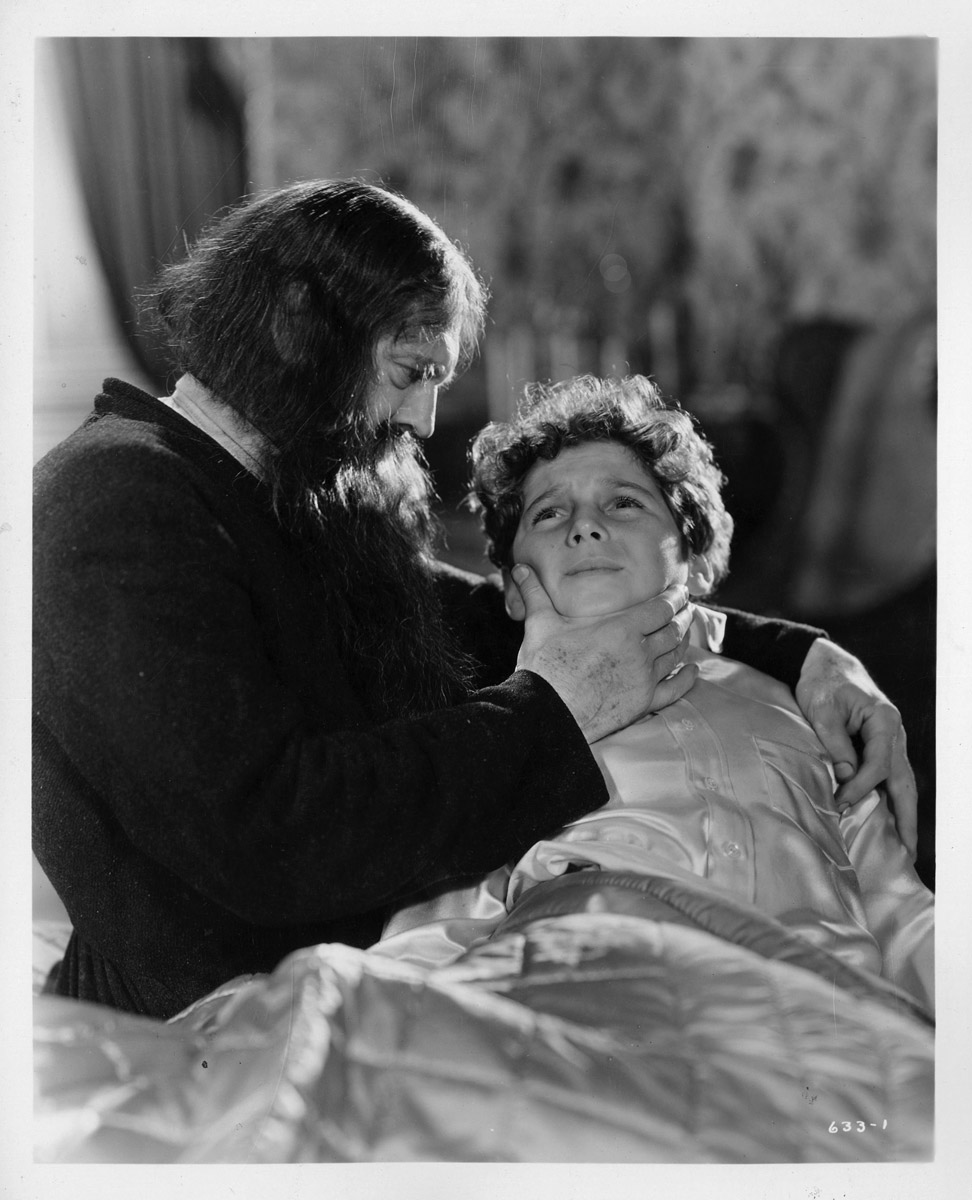
Rasputin and the Empress, somehow yet to find its way to a DVD release (note: now available via the Warner Archive collection), is a surprising film, though it’s fair to say it runs long and suffers from lackluster editing and continuity. Youthful director Richard Boleslawski, surrounded by so much talent and wealth, must have been out of his depth, though he imbues a few scenes with enough verve to make the whole affair worthwhile. Lionel Barrymore is ostensibly the star; his interpretation of Grigori Rasputin is an eye-opener — it’s at once frightening and eerie, yet never falls into the bombast or silliness that could sometimes characterize Lionel’s screen persona — particularly if one recalls his questionable Best Actor performance two years before in A Free Soul, or his much celebrated (and lampooned) turn in It’s a Wonderful Life. In fact, he inhabits the title role well enough that there are moments when one forgets the man wearing the fake beard — quite a feat considering that neither Lionel, nor any other cast member attempts an accent. You are left with the lasting impression of a powerhouse performance — one that justifies the 1931 Oscar win, and leaves viewers wishing his looks had provided him the opportunity to get away from character parts more often.


Ethel appears as the Czarina Alexandra, and in spite of the film’s nomination in the Best Writing category, her role is painfully shallow. She’s the doting mother and wife slavishly dedicated to Rasputin, though we are asked to buy into their relationship despite a lack of establishing scenes, beyond an initial meeting where Rasputin convinces her to allow him to attempt to heal the Czarevitch Aloysha (Tad Alexander), her hemophiliac son. (The mystic succeeds, though we never learn by what means, beyond some fancy hypnotic hocus-pocus involving a gold pocket watch.) It’s Ethel herself that saves the role — and in some ways the film itself — by imbuing her character with such a powerful sense of melancholy that you intuitively understand her to be the worried mother of not only a terribly fragile child, but of an equally troubled country. More than either of her brothers, it’s Ethel’s performance that serves of a constant reminder of the socio-political tumoil that serves as a backdrop for the movie’s smaller human dramas.

John Barrymore is something of a third wheel here. While his role is crucial — he plays the Russian prince who sees through Rasputin — and obviously one of the film’s three big draws, this would have been a tighter movie without his role, especially if the salvaged time had been invested in the character development of Alexandra. Yet John represented the biggest box office draw of the trio, and he does dashing quite well. And for nothing would I sacrifice the scene late in the film when he and Rasputin finally came to blows. It is simply extraordinary, and as vividly expressionistic in its violence as anything you’re likely to see from thirties MGM. Another such scene happens earlier, when Rasputin forces Aloysha to look through a microscope as a common ant and a housefly fight to the death underneath a glass slide. It’s great, scary, almost operatic stuff.

That Czar Nicholas story if a tough one to tell — after all, we all know how it ends. Rasputin and the Empress, the first of numerous relatively unsuccessful filmic attempts to tell it is an uneven, yet still compelling movie. It benefits greatly from its own gimmick: casting the three Barrymores in the same picture. However it’s the performance of Lionel that makes this so darn entertaining, and so drab when he is away from the screen. Not available on DVD, this can still be found on VHS in many libraries, and via a few internet download sources. It’s worth seeking out.

Despite its colossal production values and the presence of acting’s first family Rasputin and the Empress wasn’t the MGM film to receive a coveted Best Picture nomination — for that matter neither was Dinner at Eight. That honor surprisingly went to the Norma Shearer, Fredric March, and Leslie Howard fantasy Smilin’ Through. It’s easy to imagine Thalberg positioning the studio’s resources squarely behind wife Shearer’s project, but there’s no evidence to suggest he did so. It was really just a poor Oscar season for the movie business’s most profitable studio, with only one other film, The Prizefighter and the Lady receiving nominations. The big loser in all of this was Dinner at Eight, which was on the receiving end of the lion’s share (apologies, I couldn’t help myself) of MGM’s publicity yet failed to garner a nomination in any category — it was Oscar’s first big snub. Twentieth Century Fox (with B.P. winner Cavalcade, and nominee State Fair), Paramount (A Farewell to Arms and She Done Him Wrong), and Warner Bros. (42nd Street, Gold Diggers of 1933, and I Am a Fugitive from a Chain Gang) dominated instead — even RKO (thanks to the sensational debut of Katharine Hepburn in Morning Glory and Little Women) fared better than MGM. For the first time in the brief six-year history of the awards, Academy founder Louis B. Mayer and MGM went home empty-handed.

Rasputin and the Empress (1933)Directed by Richard Boleslawski
Starring John, Lionel, and Ethel Barrymore. With Diana Wynyard, Edward Arnold, and Ralph Morgan.
Released by MGM
Running time: 129 minutes
Availability: VHS, Warner Archive DVD on demand.

Tuesday, November 23, 2010

Man of a Thousand Faces (1957)


A note about the poster: Included above are a pair of images that provide a great deal of insight into how the studios developed posters for their films. These are both studio publicity stills shot specifically for this film, passed along to the art department for use in the poster.

James Cagney is Oscar-worthy as Lon Chaney in 1957’s glossy Man of a Thousand Faces. And for that matter, so is Dorothy Malone — so good here that she made me want to throw a brick through my television. More on that shortly.

Cagney is one of the few performers who, no matter how much praise he receives, never gets his full due. Why? No one seems to have the guts to say he was the best that ever stood in front of a camera. As hard as it is to make such a claim of any performer, especially a crazy little Irishman like Cagney, his memory begs one to try. (For that matter, so does Lon Chaney’s — but that great actor, who unfortunately falls on the wrong side of the line in my shallow mind that divides the silents and the talkies, will have to forgive me for favoring Cagney.) It’s too easy to dismiss an actor like Cagney as a “movie star” instead of an actor — people do it to Mitchum all the time. There’s no label, no matter how lofty, that can sum up Cagney’s position in movie history. He could do it all: action, drama, romance, comedy — any damn thing, even Shakespeare. He came up in Hollywood as a scene-stealer; his charisma was undeniable. And as everyone knows, he could even sing and dance, winning the 1941 Academy Award for Yankee Doodle Dandy.

His contemporaries on the Warner’s lot in the early days were Paul Muni and Edward G. Robinson, with Bogart coming on toward the end of the thirties. Yet Cagney was able to separate himself from his peers through his versatility. Muni got in his own way too often, though he had a run through the thirties as the star of big budget biopics that is practically unmatchable. Bogart’s screen presence was on par with Cagney’s, though no one would argue that his range was as broad. And then there’s Robinson: the professional, the actor’s actor. Even he admired Cagney a great deal, and lived out his life in perpetual amazement that the little Irish gentile had gotten his start in Yiddish theater. No matter where you’d place Cagney in the grand scheme of things, his depth and range are undeniable.

I like this film, it has echoes of art mirroring life — that is, if we accept the truth of Chaney’s life as presented on screen — always risky. It was fitting to cast Cagney as the silent star. Both men were versatile as hell, admittedly in very different ways, but it comes through loud and clear in his performance that Cagney, whose career was winding down in 1957, deeply understood the man whose life he was trying to interpret for the ages. The most superficial reason to watch this is to see Cagney in all of Chaney’s famous get-ups: particularly Quasimodo and the Phantom of the Opera. As far as the movie-in-a-movie stuff goes one scene stands out: as early on Cagney is called upon to do a scene as a crippled man who is miraculously healed by a traveling preacher. He throws away his crutches and slowly, agonizingly, unfolds and articulates his limbs — transforming himself from a misshapen grotesque to a normal man in excruciating slow motion. It’s impressive in two ways: not only does Cagney have to mange the physical torture of the amazing slow motion contortions of his frame, he also has to make it look like it did when Chaney did it. The scene is riveting and unforgettable.

The industry stuff aside, this is a film that at its heart is really about fathers and sons and what it means to be different. Chaney’s parents were deaf, and sign language was the primary form of communication in his boyhood home. As the film opens, we discover Chaney and his young wife Cleva (Dorothy Malone, a film noir honey mostly remembered for the long-lived TV version of Peyton Place.) trying to make a go of it in Vaudeville. The problem in their marriage, which surfaces after Cleva divulges that she’s pregnant and consequently thinks the time has come to meet Lon’s family, is that Chaney never told his young wife about his parent’s deafness. To put it lightly, Cleva does not respond well when she finally meets the parents — she flees to her room and then confesses to Chaney that she no longer wants to have her baby, for fear it will be a “freak” like her in-laws. Malone is incredible here; she really lays it all out. As a parent of small children, I found her to be so despicable and infuriating that I had to turn the film off for a little while to get a breather — I recognized that I needed a break when I caught myself screaming at the television.

Eventually Cleva delivers their son, who hears perfectly well, but by then the marriage is skidding. Cleva eventually becomes unhinged (in one particularly eye-opening scene!) and the marriage fails. Without giving too much away, the majority of the story is concerned with Chaney’s devotion to rearing his son; and how his Hollywood career develops as a result of his efforts to simply keep food on the table. (The son, Creighton, of course goes on to be known as Lon Chaney Junior, the the movie doesn’t tell that tale.) The whole thing goes easy on the sugar, and subsequently comes across nicely. There’s a lot to like here — I was engrossed from start to finish, bet you would be too.

Man of a Thousand Faces (1957)
Directed by Joe Pevney
Starring James Cagney, Dorothy Malone, Jane Greer, and Jim Backus.
Released by Universal International
Running time: 122 minutes
Availability: Widely on DVD

Saturday, November 13, 2010

The Apprenticeship of Duddy Kravitz (1974)

Richard Dreyfuss hustles his way through The Apprenticeship of Duddy Kravitz, a 1974 period film based on the novel by Mordecai Richler. The young actor, a commodity at the time and a year away from going incandescent thanks to Spielberg and Jaws, is fine as the title character, a jewish kid from Montreal who has dreams of a better future than the one facing him, either supervising workers in his uncle’s garment factory, or driving a cab like his father, played by Jack Warden.

Dreyfuss’s talent is obvious from start to finish, and the role requires a fair amount of range. As the film opens, Duddy is still a good-for-nothing-student at a military school. We follow the events of his life over the course of the next year or so, as he leaves school and begins to make connections waiting tables and schlepping bags at a summer resort. Kravitz has lots of ideas but no direction, complaining early on that he missed out on a windfall when he learned that someone else had already though up Kleenex. He finds the goal he needs when his summer crush, Yvette (Micheline Lanctôt) takes him to a nearby lake and tells him it can be had for a song. Kravitz is entranced by the vistas, and sees the surrounding real estate as his way to make his mark on the world; he begins the arduous task of trying to raise the funds to buy the property, which encompasses the rest of the film.

Most of the reels are concerned with the wheeling and dealing Kravitz goes through to make a buck, from waiting tables and making films, to selling pinball machines and driving a cab. At one point he unwittingly becomes a mule, shuttling heroin across the border and into Manhattan on behalf of the local Jewish gangster. As the film progresses and Kravitz’s need becomes more desperate he responds in kind, making a quick progression from begging and borrowing to swindling and stealing, even from those he loves. Randy Quaid, of all people, finds his way into the film as a dim witted bumpkin Duddy befriends and then takes advantage of in half a dozen different ways. Quaid is an epileptic, and the movie takes a downward emotional turn when he crashes a truck hauling Duddy’s junk from one joint to the next.

The picture’s best sequence features Denholm Elliot, a down and out filmmaker Duddy befriends after a night-school lecture. Duddy dreams up a scheme where they’ll produce Bar Mitzvah and wedding movies — “in color!” — but Elliot’s character insists on maintaining his artistic integrity. Their first project is shown in its entirety as a movie-within-a-movie and makes the whole thing worth watching. It’s a scream — really, you’ll scream — and it’ll forever change the way you think of Bar Mitzvahs and bris.

By the end of the film, we’ve witnessed a fairly original version of an age-old movie story: that of the man who fulfills his ambition, but at a terrible price. There are a few problems, particularly over length, as numerous subplots grab screen time and drain vitality from the film. Mostly they paint a picture of Jewish life in the Montreal of the fifties, but the cost is too much: such films work best in the 90-100 minute range, the extra twenty here are nearly a deal-breaker. This has never been released on home video, but is currently available to watch instantly from Netflix.

The Apprenticeship of Duddy Kravitz
(1974)
Directed by Ted Kotcheff
Starring Richard Dreyfuss, Jack Warden, Randy Quaid, and Micheline Lanctôt
Released by Canadian Film Dev. Corp.
Running time: 121 minutes.
Availability: Netflix Streaming

Saturday, November 6, 2010

Teresa (1951)

Between filming The Men with Marlon Brando and High Noon with Gary Cooper, the great director Fred Zinneman made an incredibly low key picture called Teresa, now remembered primarily as the film that introduced Anna Maria Pierangeli to American audiences. Set during the war and in the months immediately following, Teresa tells the story of Philip Cass (John Ericson) a baby-faced replacement soldier who gets off on the wrong foot with his platoon, and never manages to find solid ground among the weary G.I.s. Cass’s first taste of combat comes to a terrible conclusion when he panics and fails in his duty. He's shipped back to the aid station in a state of shock, knowing only that his cowardice got one of his fellows killed. Unlike fare produced during the war, Teresa is remarkably kind to Ericson's character — the movie demonstrates that Hollywood and the American public at large were trying to understand and come to grips with the terror of combat and the debilitating affect it could have on combatants.

Following VE day Philip is returned to his unit, where he awaits orders to ship home. During that time he meets and falls in love with Teresa (Pier Angeli), a too-young, too-thin, impossibly pretty waif of a girl. The youths are smitten with one another and quickly marry. After a brief wedding trip to Rome, Philip is ordered back to the States. Owing to the legalities of war time marriages, war bride Teresa must wait in Italy for permission to join her husband in New York. By the time it comes, Philip has settled back into his old life — with a smothering, put-upon mother (Patricia Collinge) who keeps him close to her apron and a father who can't stand up for himself — or his son. Philip is so terrified of his mother's reaction to his wedding that he refuses to tell her. She discovers his wedding photograph anyway and collapses in a fit of trumped-up sobs. The stage is set for Teresa's arrival in the city, with predictable dramatic results — high tension between everyone involved. When pregnancy complicates matters further, the situation escalates and then finally resolves itself in true Hollywood fashion.

Teresa is a well-made, well-acted film (with an Oscar-nominated story) that strangely seems borrow from Italian neo-realism: on-location shooting, unknown cast, concerned with the troubles of everyday working people. Of course this isn't a neo realist picture — it was made by MGM for Pete's sake — though the influence is readily apparent from start to finish. The movie gets a boost from familiar faces in a few small, key roles. Ralph Meeker plays Ericson's platoon sergeant, Peggy Ann Garner is fine as his sister, and even Rod Steiger himself has a tiny role as the Army shrink who tries to help Philip get over what they then referred to as “combat fatigue.”

Although this has never been given a home video release, it has aired on TCM — though not for some time. I was able to acquire a homemade copy from the last time it was shown on television. It's due to come up again, and shouldn't be missed when it does. Given the star, studio, and director, it's surprising this isn't more widely available.

Teresa (1951)
Directed by Fred Zinneman
Starring Pier Angeli and John Ericson
Released by MGM
Running time: 102 minutes.
Availability: Has aired on TCM.