Showing posts with label Oscar History. Show all posts

Wednesday, December 14, 2011

The Valiant (1929)

Thanks to TCM’s daylong celebration of the preservation efforts of the George Eastman House, I was able to view Paul Muni’s first film effort, The Valiant, directed by William K. Howard and released by Fox in 1929. The film would earn the Austrian born, New York bred Muni the first of his six Academy Award nominations, each and every one in the Best Actor category. He’d lose the second-ever Best Actor statuette to colossal movie star Warner Baxter (In Old Arizona), but Muni’s time in the sun was coming: he would be nominated four times between 1934 and 1938, winning the award in 1937 for his portrayal of Louis Pasteur. (Muni bookended nicely: his last nomination came in 1960, in his final film, The Last Angry Man.) Along with his rival at Warner Brothers, Edward G. Robinson, Muni dominated screens in the thirties — his star exploding after title roles in a pair of 1932 films, Scarface, and the astonishing I Am a Fugitive from a Chain Gang. All but forgotten by contemporary audiences, Muni was an actor’s actor and one of the biggest stars in the world. He was a chameleon, able to transform himself into whatever his role called for, whether it was suave gentility or brute physicality, regardless of age or nationality, and he could do any accent required — though he famously told Irving Thalberg that he was “about as Chinese as Herbert Hoover” when the boy wonder cast him in The Good Earth.


The Valiant opens auspiciously: Muni shoots an unseen man in some drab big city flat and wanders out onto the street, and eventually into the local precinct, where he confesses. In short order he’s thrown behind bars, tried, and sentenced to die in the electric chair at Sing Sing — a rapid-fire chain of events that Muni takes in stride. He seems resigned to his fate in moralistic, Old Testament sort of way. He tells his captors his victim deserved to die, and that he realizes that he too must be punished in accordance with the law.

The dramatic thrust of the film lies not in the identity of the victim or the motive for the crime, but in the real name of the killer himself, which Muni stubbornly refuses to divulge. Instead, he assembles the moniker “James Dyke” from a police station wall calendar. (The earliest instance of this particular film cliché I’m aware of.) Cut to the prison, where we learn that not only is Dyke a model inmate, but that his sensational case has even provided him the opportunity to write moralizing newspaper editorials, making his story and face known to a fascinated nation. In Ohio, the elderly Mrs. Douglas sees the condemned man in the paper and wonders if he could be her son Joe, gone without a trace these fifteen years. Her daughter Mary and Mary’s fiancé Robert (the popular Johnny Mack Brown) make the trip to New York in an effort to learn the truth, but although the film makes it abundantly clear to the audience that James Dyke certainly is Joe Douglas, Joe is able to convince the desperate young woman that he is not the loving older brother who used to read Romeo and Juliet to her when she was a little girl. Instead, in the sort of turn that could only happen in an early Hollywood tearjerker, “Dyke” claims to have known a man named Joe Douglas during the war, and to have seen the youth die heroically in the trenches. I’ll call it quits after this in order to spare as much of the ending as possible — Mary is then able to leave the prison with her chin up, believing that her brother died a hero and now able to return home to marry free and clear of any potential scandal.

This is an engaging movie, and thankfully it’s short enough (only 66 minutes) that one can get through it without ever feeling taxed. First is Muni: the abilities that would see him become the preeminent dramatic actor of the thirties are evident; he’s simply light years ahead of everyone else in the film in terms of ability and intuiting the medium. More than that though, Muni has that intangible something, the charisma, the screen presence, the “it” that has characterized actors such as Cagney, Dean, and De Niro throughout film history. The Valiant is a rudimentary early talkie, but Muni owns the thing.

Speaking of which, the film is notable for its technical accomplishment. While the cameras are static (there are a few close-ups), and the sets are theatrical, there are some fine “special effects” shots that appear during various flashback sequences, when a young Muni is superimposed over a medium shot of the character (usually his Whistler’s Mother-like ma) doing the remembering. And although it boasts no musical score, the sound in the Eastman print is crisp and clean, with all of the spoken dialogue easily understood. Part of that owes to the simplicity of the Oscar-nominated writing itself: a great many of the Fox theaters chains were rural (compared to those of Paramount and MGM), and consequently numerous Fox features were targeted at the uneducated or the unsophisticated, who nevertheless frequented American movie houses in droves. All of the characters deliver their lines deliberately, and with no small amount of silent-era pantomime, but it’s also apparent that the writing itself was been simplified in order to facilitate easy understanding. The narrative moral of the movie — and even its title — speak directly to rural audiences about the corruption of city life. A good mid-western boy was called to the war, and at its end was lured to the city instead of back to his home — and there he was obliged to do murder. Audiences are warned that even a young man worthy of the film’s title, The Valiant can still be ruined by the perils of the city, and that in forsaking his home and his family, he has sufficiently challenged the fates to destroy him.  

The Valiant (1929)
Directed by William K. Howard
Starring Paul Muni
Released by Fox Film Corporation (20th Century Fox) 
Running time: 66 minutes
Availability: Just aired on TCM, previously quite rare. Poor quality copies on ioffer.com. 
Grade: B, historically significant. 

Wednesday, April 27, 2011

The Patent Leather Kid (1927) & The 1st Academy Awards


How can we discuss The Patent Leather Kid, and not dedicate a few paragraphs to the very first iteration of the Academy Awards? We can’t, so hang in there and we’ll get to the film shortly — err … eventually.


The brainchild of MGM mogul Louis B. Mayer, the Academy of Motion Picture Arts and Sciences was originally formed to nullify (or mollify, if you prefer) the labor unions that were threatening to wreak havoc on industry production. As things turned out, Mayer’s cadre of power players didn’t have that kind of juice, but ever the pragmatist, he recognized that the Academy might still have some value as a PR mechanism. Concerned citizens all over the country were editorializing about the evils of the motion picture business, so Mayer imagined that the Academy could intervene with the Hays office and effectively self-police the business. The idea for the Academy Awards came a little later, after Mayer, his attorneys, and president Douglas Fairbanks managed to push $100 Academy memberships off on almost 250 more actors, writers, directors, producers, and technicians. The idea of an annual awards banquet is a natural outgrowth of such organizations, and the Academy Awards of Merit became Hollywood’s ingenious way of glamorizing itself and promoting its product to the world.

Nobody knew what to expect that first year, except for a good meal. The 270 attendees at the Hollywood Roosevelt Hotel that May evening were absolutely unconcerned about winning and losing — the results had been announced ninety days before the actual banquet was held — on the back page of the Academy Bulletin. (It wasn’t until the following year that Mayer realized the tremendous upside in keeping the results a secret until the big night.) The nomination and voting process had been painful to all involved — such things are hard to get right the first time around. Ballots actually had to be administered twice: many members failed to follow directions and nominated films from earlier years like Stella Dallas and Chaplin’s The Gold Rush, both from all the way back in 1925. Then the whole affair was almost ruined by Al Jolson and  The Jazz Singer — committee members decided it was unfair to put the landmark talkie up against silent fare, so they ruled it ineligible and instead recognized the Warners with the Academy’s first special prize. Likewise for the cinematic juggernaut known as Charles Chaplin. He was eligible in multiple categories, but the committee decided to remove his name from consideration and give him an honorary award as well — killing four separate birds with one stone by recognizing his “versatility and genius in acting, writing, directing and producing The Circus.” Chaplin was the inarguably the most famous man in the world at the time; he would have certainly swept the awards. Some authors have suggested his name was removed from ballots due to his abrasive reputation in industry circles, but this is rubbish — had Chaplin and The Circus swept the very first awards, other industry players may have lost interest and the whole enterprise could have died. It is also important to remember the depth of friendship that existed between Chaplin and Fairbanks. Regardless, for the sake of the awards themselves it proved a wise decision.


The first banquet was also a private affair — the only one not broadcast in some way to the public. For the five-dollar ticket price, guests danced and enjoyed a sumptuous meal, all hosted by master of ceremonies Fairbanks. When it was time to recognize the evening’s winners, Mayer took only five minutes to call each of them to the head table to collect their statuettes. Best Actor Emil Jannings missed the ceremony — he had already received his award and was on a steamer bound for Germany, making him officially the first winner in the awards history.* At the time performers were nominated for their body of work over the course of the eligibility period; Jannings was up for his roles in The Last Command and The Way of All Flesh, while his only fellow nominee was the much younger Richard Barthelmess, nominated for The Noose and the other subject of this essay, The Patent Leather Kid.

Twenty-one year old Janet Gaynor was named Best Actress for her work in a trio of features: Seventh Heaven, Street Angel, and Sunrise; besting Louise Dresser and Gloria Swanson, each nominated for a single performance. The practice of nominating actors and directors for multiple films would only last through the first three ceremonies, as it skewed votes towards the nominee with the most work under consideration, making an apples to apples comparison impossible. All in all, fifteen statuettes were awarded that evening in twelve categories, including Chaplin’s special award and one for the Warner Bros., for bringing The Jazz Singer to the screen. (Both cameramen recognized in the Cinematography category for Sunrise received a statuette.)

Wings was named Outstanding Picture on the strength of its commercial success, while Sunrise was given the prize for Unique and Artistic Picture. In one intriguing legend about those first awards it is said that the Board of Judges (comprised of one delegate from each of the five branches, plus Mayer) had originally selected King Vidor’s The Crowd as the winner over Sunrise, but Mayer was the lone holdout, arguing that Vidor’s depressing study of New York city life was not the credit to the industry that Sunrise was. After an all-night debate, the other judges finally gave in. Ironically, though Mayer is remembered as being rough around the edges and a something of a tyrant, he got that one right. Although The Crowd is a truly extraordinary film, Sunrise is … astonishing. What’s even more noteworthy is that The Crowd was an MGM product while Sunrise came from Fox. The shrewd foresight displayed by Mayer in arguing against his own film for one of the Academy’s most prestigious awards ruled out any possible suggestions of collusion, legitimizing the awards before they even got off the ground. The rest is history.

{* And it couldn’t have gone to a more rotten guy. In the wake of talking pictures Jannings’s thick accent made a career as a Hollywood unlikely, so the Swiss-born actor decided to head for Germany. He wrote to the Academy, asking to be given the award in advance of his ship sailing, “I therefore ask you to kindly hand me now already the statuette award to me. I want to take this opportunity to extend to you my heartfelt thanks for the honor bestowed upon me, which fills me with pride and joy which I shall cherish all my life as a kind remembrance in recognition of my artistic activities in U.S.A.” After he returned to Germany, Jannings continued to make films, most notably The Blue Angel (1930) with Marlene Dietrich. He would also sympathize with the National Socialists. Throughout the thirties he appeared in one Nazi propaganda film after another; in 1941 Goebbels bestowed upon him the title of “Artist of the State.” Jannings tried to reconnect with Hollywood after the war, but this was obviously impossible. He relocated to Austria and became a citizen of that country in 1947. He died of liver cancer three years later. His Academy statuette remains in Berlin.}
———

Richard Barthelmess’s Hollywood story began in 1916, when stage star Alla Nazimova cast him in the screen adaptation of her hit play War Brides. Barthelmess’s matinee idol looks and effortless screen presence ensured not only more roles, but stardom: he made eleven films the following year, and signed a contract with D.W. Griffith in 1919 and immediately appeared opposite Lillian Gish is a pair of films: Broken Blossoms and Way Down East, cementing his stardom. Gish would gush, “He has the most beautiful face of any man who ever went before a camera.” Barthelmess would continue as one of the biggest names in the industry, even becoming one of the original 36 founders of the Academy.

Like so many of his contemporaries, Barthelmess discovered he wasn’t nearly as well suited for the talkies, though he held on to his career a great deal longer than many: appearing in twenty sound pictures — though never in a notable performance. Barthelmess retired from acting in the mid-thirties, but returned to perform in the 1939 Howard Hawks classic Only Angels Have Wings. All in all, Barthelmess enjoyed a Hollywood career that lasted 25 years, with his greatest role coming in The Patent Leather Kid, a First national blockbuster released in 1927.

It’s a long movie, coming in at well over two hours, and it takes the acquired taste of a silent film enthusiast to get through it in a single sitting. Barthelmess plays the unnamed title character (if he’s got a real name, we never learn it), a Hell’s Kitchen prizefighter eyeing a shot at the title. Everyone in New York is rooting against him though — he’s an arrogant pug who fancies himself a dandy and insists on having his hair combed between rounds. Barthelmess looks the part: he’s an attractive and statuesque man who moves around the ring like he’s had some training. Had the movie been made a decade later, Barthelmess’s part undoubtedly would have gone to James Cagney, though the two actors are dissimilar. All of the fight scenes come over as authentic, with large crowds and believable atmosphere. It’s at one of his fights that the Kid meets Curley (Molly O’Day), a dance-hall girl who like everyone else in the arena came in hopes of seeing him knocked on his ass. Their eyes meet between, and just before putting his opponent down for the count, the Kid shouts at Curley to hang around after the fight. Intrigued, she ditches her date and lolls by the locker room door. A romance is born.

The US entry into the war is announced in one of the film’s best scenes. The Kid hears a commotion in the streets below and shouts down to the newsboy for a copy of the Times. As he scans the cover and begins to search for the sports page, we see the headline: “War Declared!” Curley enters the room and asks he’s heard the big news, but the Kid thinks she’s talking about the latest prediction of his defeat in the fight columns. The extent to which director Al Santell is able to milk the Kid’s reluctance to join the war effort is surprising, particularly given the film’s extensive running time and how abruptly it transitions from the New York fight game to the trenches of the western front. At first we think the Kid is simply disinterested in the world outside the ring — a fighter who only thinks about the fight game. Before long, as his friends enlist or are drafted, we realize he’s just scared. More than scared — he’s a coward, terrified of “guns n gas n bayonets.” After he refuses to doff his cap as the flag marches by on the street below Curley finally gives up on him, writing in a note: “I’m only a girl and can’t fight but I can dance and sing so I’m goin’ to France to cheer up the boys till I learn to be a nurse.”

Eventually the Kid is drafted, right alongside his stuttering trainer Puffy. The pair head for France as newly minted doughboys, the Kid constantly on the lookout for ways to avoid the front lines. When joining the assault becomes inevitable, he hangs back during the charge, hiding behind a tank as the men around him are chopped down. When Puffy gets hit, he implores his protégé to “give ‘em Hell!” and at the expense of the older man’s life the youth finally discovers his courage. He rises from his foxhole, grabs a satchel of grenades, and charges…

The film’s final sequence is patriotic, sentimental and a little corny, but you don’t mind so much. O’Day chews every piece of scenery in sight, frantic to score dramatic points before time runs out. Barthelmess’s final scenes are characterized by restraint, an actor understanding that the second half of the film is a great deal less about his ego than the first. This sort of redemption narrative would become the worst kind of dead horse in the years to come, beaten again and again by Hollywood as the decades, and the wars, accumulated. Big male star after big male star would make like Barthelmess in a Tinseltown rite of passage, playing arrogant, self-centered kids who go to war and learn what really matters.

The Patent Leather Kid (1927)
Directed by Alfred Santell
Starring Richard Barthelmess and Molly O’Day
Released by First National Pictures
Running time: IMDb: 130 – 150 minutes, my copy: 130 minutes.
Availability: Very Rare, though experienced film foragers can find it.

Monday, March 28, 2011

Rasputin and the Empress (1933)

Hollywood was in many ways still a small town in the early thirties, and as far as motion picture making goes, it certainly operated by a different set of rules. In 1932, Metro’s production chief Irving Thalberg, with “More Stars Than There Are In Heaven” at his disposal, had brought to the screen the first star-studded event picture. Grand Hotel was a critical and financial success for Hollywood’s biggest studio, and featured many of MGM’s top stars, from Greta Garbo and Joan Crawford to Wallace Beery and the Barrymore brothers, John and Lionel. The movie made buckets of money for Thalberg and Louis B. Mayer, and it also captured the fifth Academy Award for Best Picture. Grand Hotel’s success spawned a trend in star-laden features at MGM, many of which employed the Barrymore men. Up next was 1933’s Rasputin and the Empress; followed shortly thereafter Dinner at Eight (with Marie Dressler, Wallace Beery, Billie Burke, and Jean Harlow) and then the aviation film Night Flight (with Helen Hayes, Clark Gable, Bob Montgomery, and Myrna Loy). Each project was financial success for the studio — even the forgotten Night Flight — and each enhanced MGM’s reputation for lavish decadence at a time when the financial future of not only the movie business itself, but also the country and its inhabitants was far from certain.

Ethel Barrymore worked most often on the stage during her prime years as a performer. In fact, from age forty to sixty-five, she would only make one feature film, the subject of this essay, appearing as one half of the titular duo alongside her brother Lionel’s mad monk. She would go on to win the Best Supporting Actress Oscar in 1944 upon her return to the screen, playing Cary Grant’s mother in None But the Lonely Heart. On the heels of that success she worked steadily in film and television until her death in 1959. Consequently, 1933’s Rasputin and the Empress is the only film in which all three Barrymore siblings appear, and they are joined by Cavalcade star Diana Wynyard and the somewhat-forgotten Ralph Morgan. (Everyone knows Ralph’s younger brother Frank, but it’s worth pointing out that Ralph was a founder and the first president of the Screen Actor’s Guild.)

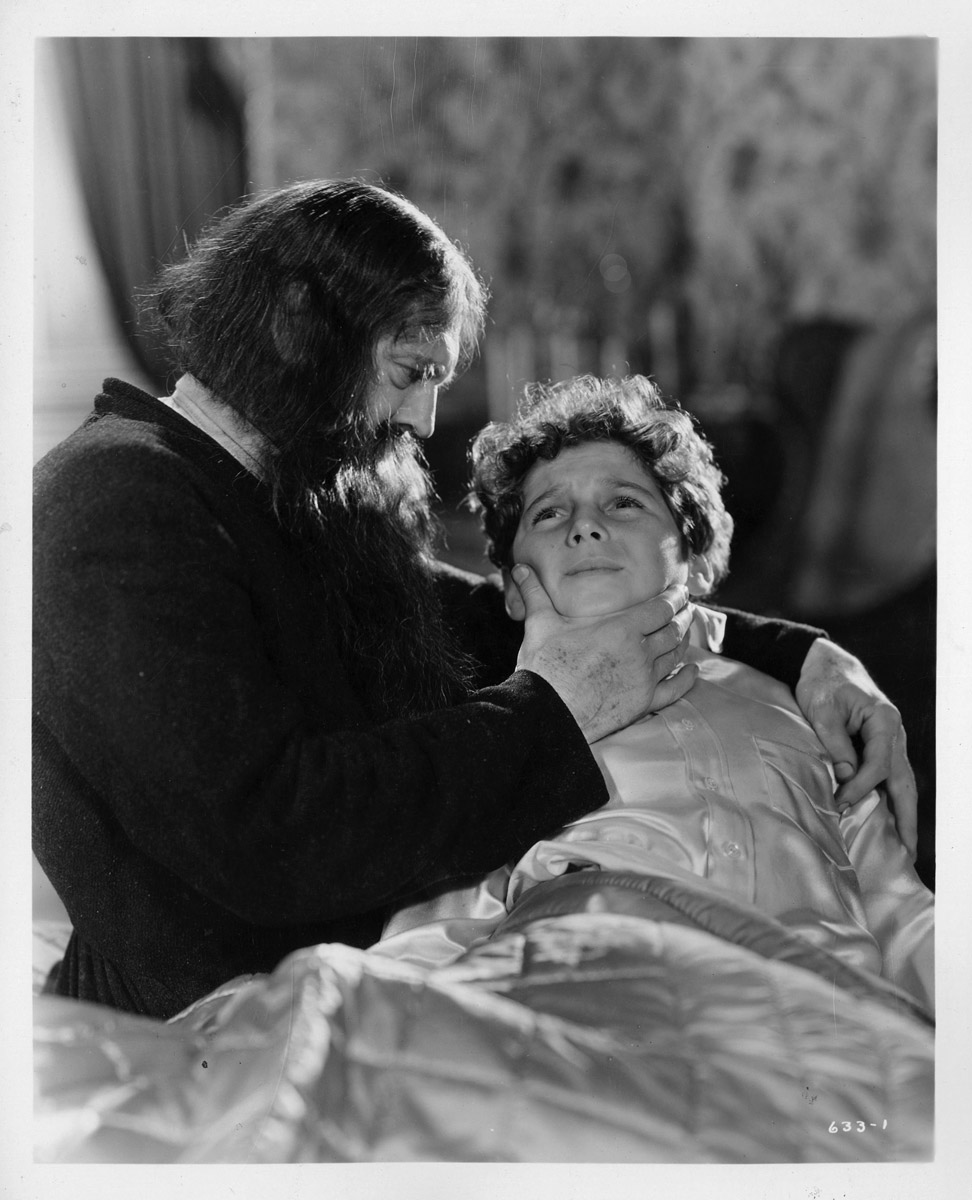
Rasputin and the Empress, somehow yet to find its way to a DVD release (note: now available via the Warner Archive collection), is a surprising film, though it’s fair to say it runs long and suffers from lackluster editing and continuity. Youthful director Richard Boleslawski, surrounded by so much talent and wealth, must have been out of his depth, though he imbues a few scenes with enough verve to make the whole affair worthwhile. Lionel Barrymore is ostensibly the star; his interpretation of Grigori Rasputin is an eye-opener — it’s at once frightening and eerie, yet never falls into the bombast or silliness that could sometimes characterize Lionel’s screen persona — particularly if one recalls his questionable Best Actor performance two years before in A Free Soul, or his much celebrated (and lampooned) turn in It’s a Wonderful Life. In fact, he inhabits the title role well enough that there are moments when one forgets the man wearing the fake beard — quite a feat considering that neither Lionel, nor any other cast member attempts an accent. You are left with the lasting impression of a powerhouse performance — one that justifies the 1931 Oscar win, and leaves viewers wishing his looks had provided him the opportunity to get away from character parts more often.


Ethel appears as the Czarina Alexandra, and in spite of the film’s nomination in the Best Writing category, her role is painfully shallow. She’s the doting mother and wife slavishly dedicated to Rasputin, though we are asked to buy into their relationship despite a lack of establishing scenes, beyond an initial meeting where Rasputin convinces her to allow him to attempt to heal the Czarevitch Aloysha (Tad Alexander), her hemophiliac son. (The mystic succeeds, though we never learn by what means, beyond some fancy hypnotic hocus-pocus involving a gold pocket watch.) It’s Ethel herself that saves the role — and in some ways the film itself — by imbuing her character with such a powerful sense of melancholy that you intuitively understand her to be the worried mother of not only a terribly fragile child, but of an equally troubled country. More than either of her brothers, it’s Ethel’s performance that serves of a constant reminder of the socio-political tumoil that serves as a backdrop for the movie’s smaller human dramas.

John Barrymore is something of a third wheel here. While his role is crucial — he plays the Russian prince who sees through Rasputin — and obviously one of the film’s three big draws, this would have been a tighter movie without his role, especially if the salvaged time had been invested in the character development of Alexandra. Yet John represented the biggest box office draw of the trio, and he does dashing quite well. And for nothing would I sacrifice the scene late in the film when he and Rasputin finally came to blows. It is simply extraordinary, and as vividly expressionistic in its violence as anything you’re likely to see from thirties MGM. Another such scene happens earlier, when Rasputin forces Aloysha to look through a microscope as a common ant and a housefly fight to the death underneath a glass slide. It’s great, scary, almost operatic stuff.

That Czar Nicholas story if a tough one to tell — after all, we all know how it ends. Rasputin and the Empress, the first of numerous relatively unsuccessful filmic attempts to tell it is an uneven, yet still compelling movie. It benefits greatly from its own gimmick: casting the three Barrymores in the same picture. However it’s the performance of Lionel that makes this so darn entertaining, and so drab when he is away from the screen. Not available on DVD, this can still be found on VHS in many libraries, and via a few internet download sources. It’s worth seeking out.

Despite its colossal production values and the presence of acting’s first family Rasputin and the Empress wasn’t the MGM film to receive a coveted Best Picture nomination — for that matter neither was Dinner at Eight. That honor surprisingly went to the Norma Shearer, Fredric March, and Leslie Howard fantasy Smilin’ Through. It’s easy to imagine Thalberg positioning the studio’s resources squarely behind wife Shearer’s project, but there’s no evidence to suggest he did so. It was really just a poor Oscar season for the movie business’s most profitable studio, with only one other film, The Prizefighter and the Lady receiving nominations. The big loser in all of this was Dinner at Eight, which was on the receiving end of the lion’s share (apologies, I couldn’t help myself) of MGM’s publicity yet failed to garner a nomination in any category — it was Oscar’s first big snub. Twentieth Century Fox (with B.P. winner Cavalcade, and nominee State Fair), Paramount (A Farewell to Arms and She Done Him Wrong), and Warner Bros. (42nd Street, Gold Diggers of 1933, and I Am a Fugitive from a Chain Gang) dominated instead — even RKO (thanks to the sensational debut of Katharine Hepburn in Morning Glory and Little Women) fared better than MGM. For the first time in the brief six-year history of the awards, Academy founder Louis B. Mayer and MGM went home empty-handed.

Rasputin and the Empress (1933)Directed by Richard Boleslawski
Starring John, Lionel, and Ethel Barrymore. With Diana Wynyard, Edward Arnold, and Ralph Morgan.
Released by MGM
Running time: 129 minutes
Availability: VHS, Warner Archive DVD on demand.

Wednesday, July 7, 2010

THE OSCAR (1966), Frank Capra, and It’s a Wonderful Life

Frank Capra, a brilliant a determined man who enjoyed everything Hollywood has to offer, learned a hard lesson over the course of his career — a mean sonofabitch of a lesson that Hollywood has taught to thousands and thousands over the decades: there’s no such thing as absolute control in the movie business. Picture making is a collaborative process — whether you like it or not — and everyone from the extras crowded around the hospitality table to Louis B. Mayer himself answers to somebody. This is why I, as well as every screen writer and cinematographer in the world, chuckle at author-theory people. Frankie Fane, the rotten protagonist of The Oscar, learns this too.

What’s Capra got to do with it though?

Here’s an oft-told Oscar tale: in 1934 the race for Best Director was contested among three nominees: Capra for Lady for a Day, George Cukor for Little Women, and Frank Lloyd for Best Picture winner Cavalcade. The presenter that year was humorist and film comedian Will Rogers — probably the sharpest, make that wickedest, man in the room. He declared the winner by jovially announcing, “Well, well, well. What do you know. I’ve watched this young man for a long time. Saw him come up from the bottom, and I mean the bottom. It couldn’t have happened to a nicer guy. Come on up and get it, Frank!” At this, Capra stood and wound his way through the tables toward the stage. He looked over and saw a jubilant Frank Lloyd, — the real winner — also coming up from his left. After a moment’s confusion Capra returned to his seat, humiliated, in what he would later describe as the “longest walk of his life.”

Capra was a filmmaker who greatly valued the creative aspects of his work and desperately wanted to win an Academy Award. He felt the accompanying recognition would give him enough juice to exert more and more control over his pictures. The irony here is that although he would shortly become one of the most recognized directors in film history, capturing the Oscar the following year for his own Best Picture, It Happened One Night, and winning it an astonishing two more times before the decade was out; he would never get the control he wanted — nobody ever does. Following his return from the war he even formed his own independent production company, Liberty Films, in an effort to gain more authority over his work. (Though it certainly fair to suggest that he had another reason: to pay less in taxes.) Liberty produced only two pictures — one of which was It’s a Wonderful Life.

Irony: Although Capra finally had a measure of the control he desired, It’s a Wonderful Life was a flop with post-war audiences — meaning that for their part the studio people were right. It failed to recoup its production costs and consequently drove Liberty into foreclosure and Capra back to the studio shuck-and-jive. More irony: in the decades since its release It’s a Wonderful Life has become one of the most adored films in history — a bona fide American classic — proving that for his part Capra was right. Even more irony: Lovers of this film often cite the source of their affection as the movie’s sweet Christmas message, though this shocks me. I believe what they are actually drawn to is the nostalgia of the film’s Americana, combined with its proliferation on television. My friends, It’s a Wonderful Life is a dark, forbidding, and troubling film.

Why the story? I was aware of the 1934 Oscar debacle’s connection to The Oscar and Capra was constantly in my thoughts as I watched. When one considers all the possibilities of a movie bearing this most lofty of titles it’s surprising — and something of a let-down — to witness the results — though Harlan Ellison was probably thinking of Capra when he had the “What if?” moment that probably got the this screenplay off the ground. The film itself has nothing to do with Capra and everything to do with an actor learning that old Hollywood lesson.

The Oscar stars Irishman Stephen Boyd (who most viewers will remember as Charlton Heston’s rival in 1959 Best Picture Ben-Hur) as Frankie Fane, a opportunistic heel who grinds his way through Hollywood, stepping on or over everyone who gets in his path. Fane is gifted with good looks and talent, but he’s so pathologically despicable that even shallow Hollywood types can’t stand him. The desperate and terrified actor’s career has finally hit the skids when he receives what amounts to a gift from the heavens: an Academy Award nomination for best actor. Yet the revivification certain to accompany the nod isn’t enough for Fane, he’s looking to hedge his bets — and in the end he pays a terrible price.

The supporting cast of The Oscar is noteworthy for being … noteworthy. This is one of those pictures about pictures that was able to recruit a boatload of high profile guest stars: Milton Berle plays Boyd’s agent while Joe Cotten is his studio boss. The film’s women are played by Elke Sommer, Eleanor Parker, Edie Adams, and Jill St. John. Ernest Borgnine is featured as a sleazy private eye; Brod Crawford, Walter Brennan, Peter Lawford, and Ed Begley do bits; and crooner Tony Bennett turns in his one and only (not too bad either) performance as a dramatic actor in the second lead. Bennett plays Hymie, Frank’s right hand man, conscience, and stooge. There are cameos galore, with Edith Head, Hedda Hopper, Frank Sinatra, Merle Oberon, and Bob Hope showing up as themselves.

The Oscar is both a morality story about the high cost of low morals and a trashy melodrama about life in the picture business. Whether it succeeds or fails on either count is up to the individual viewer, but the movie is stylish as can be (Oscar nods for Art Direction and Costume Design) and one hell of a ride — in a Jacqueline Susann kind of way.

The Oscar (1966)
Grade: C-
Directed by Russell Rouse
Starring Stephen Boyd, Elke Sommer, Tony Bennett, Milton Berle, and many more.
Released by Embassy Pictures
Running time: 119 minutes
Availability: Airs on TCM, rarely.