Showing posts with label MGM. Show all posts

Tuesday, April 8, 2014

Blackmail (1939)


Edward G. Robinson was flying high in 1939, confident and comfortable in his position near the top of the Hollywood heap. His box office appeal was such that he could be successfully cast in nearly anything, which possibly explains his turn in Metro’s seldom-seen Blackmail, which only vaguely resembles that other chain gang picture.

An oddly cast Eddie plays John Harrington, a wrongly imprisoned man who escapes a Deep South chain gang and starts a new life with a new name—John Ingram—with his wife (Ruth Hussey, wasted here) and son (Bobs Watson) in Oklahoma as, of all things, an oil field fire fighter. Whenever a gusher turns into a flamethrower, John and partner Moose (Guinn Williams) swoop in with nitroglycerine, dynamite, and asbestos suits and blow the inferno to kingdom come. But after a newsreel crew records some of his exploits, John’s past comes back to haunt him and he soon finds himself returned to the chain gang, craving revenge against the man “old friend” (Gene Lockhart) who blackmailed and betrayed him.

Robinson was still under contract at his home studio, Warner Bros. in 1939, and made this quick actioner on loan-out to MGM. Given the status of the performer and the studio, it’s somewhat surprising to see that Blackmail only rates 244 votes on IMDb. And while Robinson jolts any film he appears in, this is certainly one of his weakest star outings, and I spent much of my viewing time wondering if a different, and ugh—younger, taller—star, may have made for a better film. Nevertheless, at just 81 minutes this moves quickly and travels from location to location with the sort of polish that one expects from MGM—even MGM trying their best to do a Warner’s picture. The fire scenes are exciting and have a convincing sense of verisimilitude (not too much rear projection); the chain gang sequences somewhat less so, but only because they were created on the lot rather than in Louisiana, and because Eddie just can’t swing a pick axe with the same aplomb with which he brandishes a Tommy gun. However he does shine throughout the escape sequence, particularly when he clings desperately to the axle of a fruit truck as it barrels down a rocky unpaved road. It’s tense, scary stuff.

In the end Blackmail is an only mildly striking conflation of Warner Bros. exposé and Metro spectacle, albeit with one of the truly great stars. Light fare from Robinson’s most prolific period.

Read the biography of Edward G. Robinson I wrote for the Film Noir Foundation’s Noir City magazine at this link. 

Blackmail (1939)
Starring Edward G. Robinson, Ruth Hussey, and Gene Lockhart.
Directed by H.C Potter
Running time: 81 minutes
Availability: airs on TCM
Grade: C+


Tuesday, October 16, 2012

Billy Rose’s Jumbo (1962)


It isn’t often that an MGM musical misses, but in the case of Billy Rose’s Jumbo the arrow flies well wide of the mark. Based on the 1935 play of the same name, it is said that the old Broadway showman, in a fit of ego, insisted that the filmed version — produced some twenty-five years later — use the complete title. It’s clear that as nostalgic as the final product actually is, MGM must have conceded grudgingly — it’s a terrible title.

The 1962 film employs that peculiar sixties casting strategy of pairing two younger stars with two older stars in order to appease multiple generations of movie-goers. Forties icons Jimmy Durante and Martha Raye appear as the proprietors of the Wonder Circus, a small outfit constantly on the verge of falling apart. Durante’s Pop Wonder is always finding ways to make do as the better acts flee for circus jobs that — ahem — actually pay a salary. Doris Day plays Pop’s daughter Kitty. She’s a clever girl who knows the angles, and is always scrambling to keep the circus wheels turning, especially on those occasions that Pop loses the night’s take at the craps table. Day’s part was originally intended for Debbie Reynolds, and certainly Jumbo would be a different film with her in the lead. Day in Calamity Jane aside, the more athletic Reynolds always did better in those “regular folks” sorts of parts (The Unsinkable Molly Brown, The Mating Game) than Day, who almost seems like she’s slogging her way through this picture in an attempt to avoid getting dirty. Regardless, Doris isn’t the film’s problem. That honor belongs to Stephen Boyd, of Ben-Hur and The Oscar fame. Why Boyd was cast as love interest Sam Noble is a mystery; the sixties answer to Dana Andrews is far too intense and not nearly talented enough musically to make a go of it. He and Day are jigsaw pieces from different puzzles — they’re just not compatible. Why put America’s sweetheart next to an actor who’s entire screen persona can be summed up in one word: brooding?

Jumbo, in any case, refers to the star attraction of the Wonder Circus, a versatile elephant at the center of many of the film’s production numbers. The Rodgers and Hart songs are good enough, but something here just doesn’t feel right: by 1962 the notion of characters slipping from conversation into song doesn’t come across the same way it did in the previous decade, even if we are in the realm of period subject matter. (For further proof of this, check out the Disney film The Happiest Millionaire — and it comes in at nearly three hours). Fred Astaire could do it and it was charming, but in the wake of West Side Story the musical had changed, and these abrupt segues to melody became rather difficult to swallow. At any rate, the story revolves around the hostile takeover of the Wonder Circus, and Jumbo in particular, by John Noble (Dean Jagger), who has been secretly purchasing all of Pop’s debt from a veritable army of creditors. And guess what? Noble is also Sam’s father, which leads to a pedestrian sequence of romantic complications between Boyd and Day, that resolve predictably by film’s end. You can practically predict the dialogue. 

Watch this if you are a die-hard fan or Doris Day or the music of Rodgers and Hart, or even nostalgic for Durante and Ray. With a running time in excess of two hours, those looking to pass the time should try elsewhere. 

Billy Rose’s Jumbo
Directed by Charles Waters
Starring Doris Day, Stephen Boyd, Jimmy Durante, and Martha Raye
Released by MGM
Running time: 127 minutes
Grade C-

Sunday, May 22, 2011

Golden Girl (1951) and Les Girls (1957)

Mitzi Gaynor is a recent re-discovery for me, having never been a fan of South Pacific, which I saw once eons ago and promptly moved on from. I just watched a much younger Mitzi in 1951’s Golden Girl, and found something in her first featured performance quite endearing. The forgotten film casts Mitzi as Gold Rush honey Lotta Crabtree, making her name as a performer in the mining camps throughout California during the Civil War period. There’s not much to speak for Golden Girl beyond Gaynor — the songs aren’t memorable and the romance with a dashing southern spy / officer (TV Western star Dale Robertson) who robs Union payrolls feels dated and a little uncomfortable. The climax finds Gaynor bleating a tearful rendition of Dixie in a high-falootin’ San Francisco auditorium just as news of the surrender at Appomattox has made its way west. Golden Girl has never been released on DVD (or VHS?), and the print showing on Turner Classic Movies is so poor as to not bode well for its future. On a side note, the poster for Golden Girl is simply one of the most awful I’ve ever seen.

And then there’s Les Girls. If it were not for Mitzi, whose part is too small for my tastes, I would have liked it a great deal less. If you are a fan of MGM musicals however, Les Girls is available everywhere and is a film that you simply have to see, even if I say that in a somewhat weary, obligatory tone of voice (being a completist has its downside). The production values are as sumptuous and as artistic as anything else Metro did during the period — particularly in Mitzi’s big number towards the end of the film. (The film was an Oscar winner for its costumes.) The narrative gets a little tedious though: the story is centers around a London courtroom libel suit that finds two of Gene Kelly’s former troupers — Les Girls — at each others throats over a tell-all book one has just written. The same set of events are related three times, each time through the eyes of a different character, and before long we see way in which all the strings are going to tie neatly together.

In addition to Gaynor and Gene Kelly, the film casts lanky Brit Kay Kendall as the author of the tell-all, and sexy Finn Taina Elg as the libeled lady. Elg was certainly a stunner, but she never really caught on with American audiences, while Kendall had all the talent in the world yet never had a fighting chance to use it — she would succumb to leukemia two short years later, in 1959. While each of the girls brings something worthwhile to the film, they never quite gel on screen together in the way they do with their male costars, and the movie suffers a little for it.

The biggest drawback for me is that this is yet another late-cycle musical that fails to properly integrate the musical numbers into the story. As so often became the case as the fifties grew tired, the musical interludes show up like television commercial breaks — here in the form of the Les Girls nightclub acts, each one a little more artsy-fartsy and self indulgent than the last. (And don’t get me wrong either, I think An American in Paris is great stuff!) This is not a bad film by any means, but it is rather soul-less and clearly shows that the musical was running on fumes in 1957, and desperately needed the shot in the arm that West Side Story was stirring up on Broadway at the time, and would in a few years give the motion picture musical.

At almost 80, Mitzi is still out there somewhere, though her motion picture career was too damn short: eighteen credits, and no big screen work after 1963. She did a number of TV specials in the seventies, but they are nowhere to be found. It’s too bad, Gaynor had a look, style, and screen presence that doesn’t translate to photography — you’ve gotta see her in films.


Golden Girl (1951)
Directed by Lloyd Bacon
Starring Mitzi Gaynor, Dale Robertson, and Una Merkel
Released by Twentieth Century Fox
Running time: 108 minutes.
Availability: Has aired on TCM

Les Girls (1957)
Directed by George Cukor
Starring Mitzi Gaynor, Gene Kelly, Kay Kendall, and Taina Elg
Released by MGM
Running time: 114 minutes.
Availability: Widely on DVD, airs on TCM

Monday, March 28, 2011

Rasputin and the Empress (1933)

Hollywood was in many ways still a small town in the early thirties, and as far as motion picture making goes, it certainly operated by a different set of rules. In 1932, Metro’s production chief Irving Thalberg, with “More Stars Than There Are In Heaven” at his disposal, had brought to the screen the first star-studded event picture. Grand Hotel was a critical and financial success for Hollywood’s biggest studio, and featured many of MGM’s top stars, from Greta Garbo and Joan Crawford to Wallace Beery and the Barrymore brothers, John and Lionel. The movie made buckets of money for Thalberg and Louis B. Mayer, and it also captured the fifth Academy Award for Best Picture. Grand Hotel’s success spawned a trend in star-laden features at MGM, many of which employed the Barrymore men. Up next was 1933’s Rasputin and the Empress; followed shortly thereafter Dinner at Eight (with Marie Dressler, Wallace Beery, Billie Burke, and Jean Harlow) and then the aviation film Night Flight (with Helen Hayes, Clark Gable, Bob Montgomery, and Myrna Loy). Each project was financial success for the studio — even the forgotten Night Flight — and each enhanced MGM’s reputation for lavish decadence at a time when the financial future of not only the movie business itself, but also the country and its inhabitants was far from certain.

Ethel Barrymore worked most often on the stage during her prime years as a performer. In fact, from age forty to sixty-five, she would only make one feature film, the subject of this essay, appearing as one half of the titular duo alongside her brother Lionel’s mad monk. She would go on to win the Best Supporting Actress Oscar in 1944 upon her return to the screen, playing Cary Grant’s mother in None But the Lonely Heart. On the heels of that success she worked steadily in film and television until her death in 1959. Consequently, 1933’s Rasputin and the Empress is the only film in which all three Barrymore siblings appear, and they are joined by Cavalcade star Diana Wynyard and the somewhat-forgotten Ralph Morgan. (Everyone knows Ralph’s younger brother Frank, but it’s worth pointing out that Ralph was a founder and the first president of the Screen Actor’s Guild.)

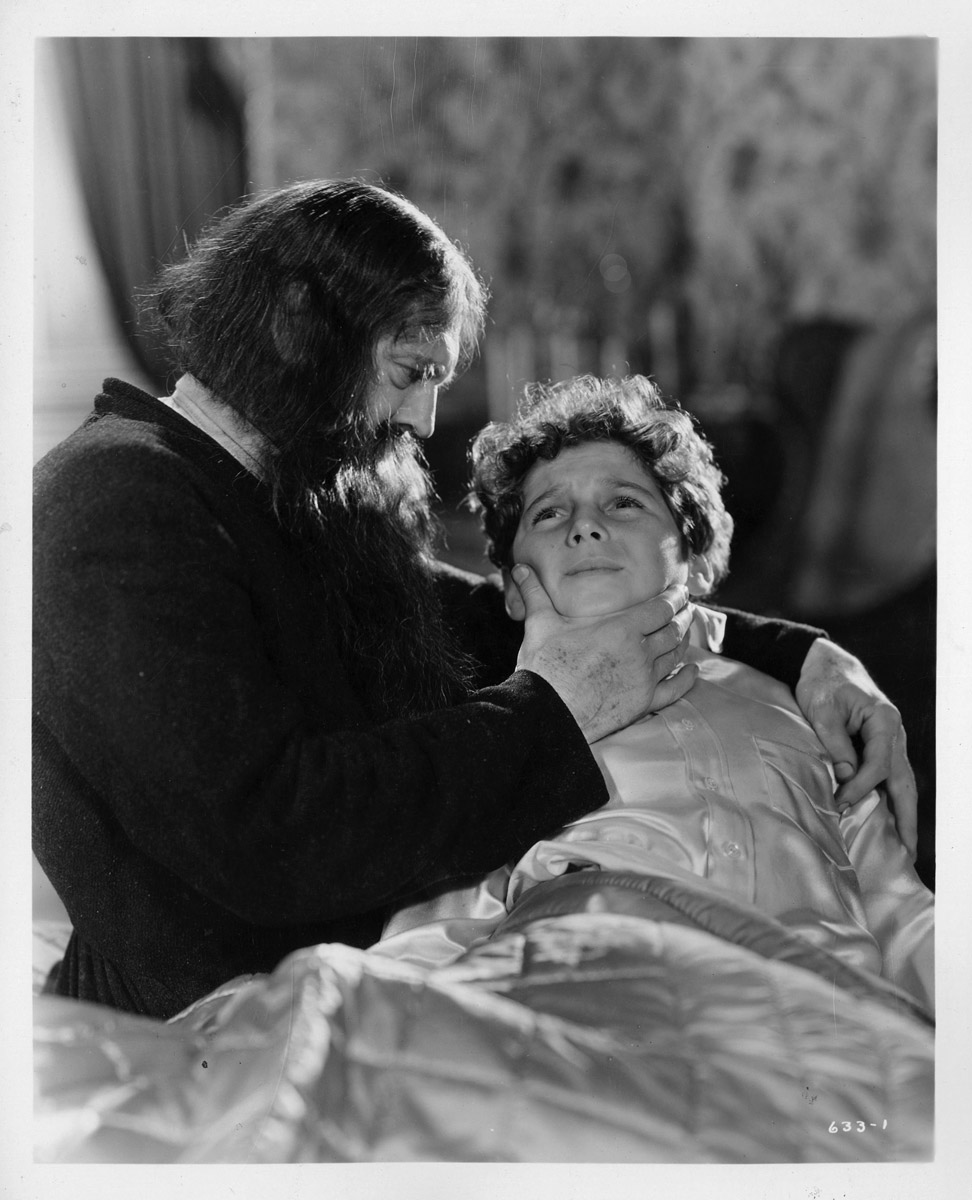
Rasputin and the Empress, somehow yet to find its way to a DVD release (note: now available via the Warner Archive collection), is a surprising film, though it’s fair to say it runs long and suffers from lackluster editing and continuity. Youthful director Richard Boleslawski, surrounded by so much talent and wealth, must have been out of his depth, though he imbues a few scenes with enough verve to make the whole affair worthwhile. Lionel Barrymore is ostensibly the star; his interpretation of Grigori Rasputin is an eye-opener — it’s at once frightening and eerie, yet never falls into the bombast or silliness that could sometimes characterize Lionel’s screen persona — particularly if one recalls his questionable Best Actor performance two years before in A Free Soul, or his much celebrated (and lampooned) turn in It’s a Wonderful Life. In fact, he inhabits the title role well enough that there are moments when one forgets the man wearing the fake beard — quite a feat considering that neither Lionel, nor any other cast member attempts an accent. You are left with the lasting impression of a powerhouse performance — one that justifies the 1931 Oscar win, and leaves viewers wishing his looks had provided him the opportunity to get away from character parts more often.


Ethel appears as the Czarina Alexandra, and in spite of the film’s nomination in the Best Writing category, her role is painfully shallow. She’s the doting mother and wife slavishly dedicated to Rasputin, though we are asked to buy into their relationship despite a lack of establishing scenes, beyond an initial meeting where Rasputin convinces her to allow him to attempt to heal the Czarevitch Aloysha (Tad Alexander), her hemophiliac son. (The mystic succeeds, though we never learn by what means, beyond some fancy hypnotic hocus-pocus involving a gold pocket watch.) It’s Ethel herself that saves the role — and in some ways the film itself — by imbuing her character with such a powerful sense of melancholy that you intuitively understand her to be the worried mother of not only a terribly fragile child, but of an equally troubled country. More than either of her brothers, it’s Ethel’s performance that serves of a constant reminder of the socio-political tumoil that serves as a backdrop for the movie’s smaller human dramas.

John Barrymore is something of a third wheel here. While his role is crucial — he plays the Russian prince who sees through Rasputin — and obviously one of the film’s three big draws, this would have been a tighter movie without his role, especially if the salvaged time had been invested in the character development of Alexandra. Yet John represented the biggest box office draw of the trio, and he does dashing quite well. And for nothing would I sacrifice the scene late in the film when he and Rasputin finally came to blows. It is simply extraordinary, and as vividly expressionistic in its violence as anything you’re likely to see from thirties MGM. Another such scene happens earlier, when Rasputin forces Aloysha to look through a microscope as a common ant and a housefly fight to the death underneath a glass slide. It’s great, scary, almost operatic stuff.

That Czar Nicholas story if a tough one to tell — after all, we all know how it ends. Rasputin and the Empress, the first of numerous relatively unsuccessful filmic attempts to tell it is an uneven, yet still compelling movie. It benefits greatly from its own gimmick: casting the three Barrymores in the same picture. However it’s the performance of Lionel that makes this so darn entertaining, and so drab when he is away from the screen. Not available on DVD, this can still be found on VHS in many libraries, and via a few internet download sources. It’s worth seeking out.

Despite its colossal production values and the presence of acting’s first family Rasputin and the Empress wasn’t the MGM film to receive a coveted Best Picture nomination — for that matter neither was Dinner at Eight. That honor surprisingly went to the Norma Shearer, Fredric March, and Leslie Howard fantasy Smilin’ Through. It’s easy to imagine Thalberg positioning the studio’s resources squarely behind wife Shearer’s project, but there’s no evidence to suggest he did so. It was really just a poor Oscar season for the movie business’s most profitable studio, with only one other film, The Prizefighter and the Lady receiving nominations. The big loser in all of this was Dinner at Eight, which was on the receiving end of the lion’s share (apologies, I couldn’t help myself) of MGM’s publicity yet failed to garner a nomination in any category — it was Oscar’s first big snub. Twentieth Century Fox (with B.P. winner Cavalcade, and nominee State Fair), Paramount (A Farewell to Arms and She Done Him Wrong), and Warner Bros. (42nd Street, Gold Diggers of 1933, and I Am a Fugitive from a Chain Gang) dominated instead — even RKO (thanks to the sensational debut of Katharine Hepburn in Morning Glory and Little Women) fared better than MGM. For the first time in the brief six-year history of the awards, Academy founder Louis B. Mayer and MGM went home empty-handed.

Rasputin and the Empress (1933)Directed by Richard Boleslawski
Starring John, Lionel, and Ethel Barrymore. With Diana Wynyard, Edward Arnold, and Ralph Morgan.
Released by MGM
Running time: 129 minutes
Availability: VHS, Warner Archive DVD on demand.

Tuesday, December 7, 2010

Torch Song (1953)


I'll probably return to this film later, but I just finished it and wanted to get my initial thoughts down, before I lose them in memories of pancake makeup (see above). Joan Crawford is a hot-button actress among classic film watchers — everyone has a strong opinion. After all these years and films, I still can't understand those who don't respect her, even if grudgingly. What has always drawn me to Joan and her work is that for a woman who was a perfectionist, and notoriously particular about how she was dressed and photographed, she was willing to give a great deal of herself to her roles, often in ways that were hardly flattering. Torch Song is a great example.

In Torch Song we meet Jenny Stewart, a Broadway star who got her spotlight by giving everything to her audience, always placing their needs first. For Jenny this philosophy becomes the crutch she uses against loneliness, and the club she wields to always get things done her way — which is almost always turns out to the best way. This is melodrama though, so of course Jenny is alone and without love, having domineered or alienated every man in her life. She's so abrasive she lacks female companionship as well. Aside from her maid, every guest at a party she throws is male, and none show the slightest interest in her affections. Only playboy / gigalo Cliff Willard (Gig Young) even gives her the time of day, and that's because she picks up his tabs. Miss Stewart, though Joan plays her sweet in private, is an ice queen.

The film itself is a colossal disaster, and exists firmly within the universe of camp — the colors are garish, the costumes are gaudy, and the dialog is over the top. (For over the top dialog though, it sure has some zing — this is one quotable movie.) And there there's the black-face number, Two-faced Woman. If the thing weren't so humiliating for those involved the film would likely never have seen a DVD release. Once you've seen it you'll understand that no amount of reproach will ever equal the embarrassment that had to be felt by those taking part in the film. At least the makeup would allow everyone involved, except Joan of course, to deny their involvement later.

What I love about this film is the focus on Joan's physical features. The movie takes great pains to showcase Joan's figure in a number of early scenes. Whether dancing, singing, or just sitting, we get to see plenty of the 48 year old's legs, midriff, and bare shoulders. Realizing that these things are happening in the film, one can't help but recognize that Crawford the actress is also vamping for your attention. Just when you are starting to think it all reeks of desperation on the part of the actress, not the character, a 15 foot tall cardboard cutout of Jenny Stewart in a showgirl outfit is delivered backstage, where Stewart pulls up her skirt just to compare the likeness that you realize that Crawford the actress is giving us this, humiliating herself just a little, in order to make Stewart are more human character. What Joan lacked in looks or talent, she made up in sacrifice; and this great quality is on display time and again in her work. It's the thing about Joan that allowed her to take mediocre material like Torch Song, and turn it into something you can't stop watching.

Maybe this was a case of art imitating life after all, but by the mid fifties the great parts for Joan and Bette were in the rear view mirror, and Baby Jane was still a decade away. As Joan herself said “You have to work with what they give you.”

At least she made the best of it.

Torch Song (1953)
Director: Charles Walters
Screenplay: John Michael Hayes and Jan Lustig
Starring: Joan Crawford, Michael Wilding, Gig Young, Marjorie Rambeau, and Harry Morgan.
Released by: MGM
Running time: 90 minutes
Availability: Widely on DVD

Saturday, November 6, 2010

Teresa (1951)

Between filming The Men with Marlon Brando and High Noon with Gary Cooper, the great director Fred Zinneman made an incredibly low key picture called Teresa, now remembered primarily as the film that introduced Anna Maria Pierangeli to American audiences. Set during the war and in the months immediately following, Teresa tells the story of Philip Cass (John Ericson) a baby-faced replacement soldier who gets off on the wrong foot with his platoon, and never manages to find solid ground among the weary G.I.s. Cass’s first taste of combat comes to a terrible conclusion when he panics and fails in his duty. He's shipped back to the aid station in a state of shock, knowing only that his cowardice got one of his fellows killed. Unlike fare produced during the war, Teresa is remarkably kind to Ericson's character — the movie demonstrates that Hollywood and the American public at large were trying to understand and come to grips with the terror of combat and the debilitating affect it could have on combatants.

Following VE day Philip is returned to his unit, where he awaits orders to ship home. During that time he meets and falls in love with Teresa (Pier Angeli), a too-young, too-thin, impossibly pretty waif of a girl. The youths are smitten with one another and quickly marry. After a brief wedding trip to Rome, Philip is ordered back to the States. Owing to the legalities of war time marriages, war bride Teresa must wait in Italy for permission to join her husband in New York. By the time it comes, Philip has settled back into his old life — with a smothering, put-upon mother (Patricia Collinge) who keeps him close to her apron and a father who can't stand up for himself — or his son. Philip is so terrified of his mother's reaction to his wedding that he refuses to tell her. She discovers his wedding photograph anyway and collapses in a fit of trumped-up sobs. The stage is set for Teresa's arrival in the city, with predictable dramatic results — high tension between everyone involved. When pregnancy complicates matters further, the situation escalates and then finally resolves itself in true Hollywood fashion.

Teresa is a well-made, well-acted film (with an Oscar-nominated story) that strangely seems borrow from Italian neo-realism: on-location shooting, unknown cast, concerned with the troubles of everyday working people. Of course this isn't a neo realist picture — it was made by MGM for Pete's sake — though the influence is readily apparent from start to finish. The movie gets a boost from familiar faces in a few small, key roles. Ralph Meeker plays Ericson's platoon sergeant, Peggy Ann Garner is fine as his sister, and even Rod Steiger himself has a tiny role as the Army shrink who tries to help Philip get over what they then referred to as “combat fatigue.”

Although this has never been given a home video release, it has aired on TCM — though not for some time. I was able to acquire a homemade copy from the last time it was shown on television. It's due to come up again, and shouldn't be missed when it does. Given the star, studio, and director, it's surprising this isn't more widely available.

Teresa (1951)
Directed by Fred Zinneman
Starring Pier Angeli and John Ericson
Released by MGM
Running time: 102 minutes.
Availability: Has aired on TCM.

Friday, July 16, 2010

For Me and My Gal (1942)


Having spent a great deal of time in recent weeks watching and rewatching musicals made during the Second World War, I’ve come to the conclusion that For Me and My Gal might be the best of the bunch. Produced by Arthur Freed and ably directed by none other than Busby Berkeley, For Me and My Gal is probably most well-known for being the screen debut of Gene Kelly. Yet Kelly’s debut aside this is still a fine wartime musical, of which charming may be the most appropriate one-word description.

The film represents the first of three pairings [The Pirate (1948) and Summer Stock (1950) being the other two], of young stars Gene Kelly and Judy Garland. Kelly left Broadway at the behest of David O. Selznick to come west as a replacement for the previously cast Dan Dailey, and he never looked back. The film is also evidence that Kelly didn't have much of a learning curve either — he looks almost as polished here as he does in any of his legendary fifties roles. Yet at age twenty Judy Garland was a screen veteran. But For Me and My Gal wasn’t just another film for her, it represented her first truly grown up role, and a testing of the waters away from her usual male lead, Mickey Rooney.

I’ve never considered myself much of a Judy Garland fan, but I have always clearly recognized the it that made her one of the screen’s great stars. And although I have always adored Deanna Durbin, Judy’s talent is such that you can’t hold Louis B. Mayer’s famous decision against him. Still, I usually struggle to hit the play button on a Garland film, but once it gets going I’m
always somehow inexorably pulled in. There’s just something charismatic about Judy — some vulnerability — that draws you into her performances, and unlike other stars she accomplishes this magic without being overtly sexual. It’s almost as if Judy comes across as a little sister whose happiness you desperately want to ensure. She has fine romantic chemistry with Kelly, and the young couple’s numbers together are tops. I’ve seen so many films that I hold every performer’s individual role against the arc of his career, so when Garland and Kelly sing and dance the title number of For Me and My Gal in a deserted coffee shop, the effect is marvelous. On its own merits it’s a great number, but attaching the weight of the careers and the great routines that this one portends leaves one with chills.

Unlike other rah-rah musicals of the War era, this one is something of a period piece: it’s set in the Great War. Gene and Judy are vaudevilleians who meet, fall in love, and set their hearts on playing the Palace on Broadway — the dream destination for those slogging and hoofing on the circuit. The dramatic tension comes after the US enters the war, and circumstances contrive for Judy to believe Gene a coward. They try to go their separate ways but are thrown together once again, this time overseas doing the USO thing (YMCA during WWI). Of course Gene’s no coward, but Judy has to learn it the hard way. The film is light on propaganda, which makes it moving moments all the more effective — and there are a few of them. By the fade out I was ready to load up on war bonds.

For Me and My Gal (1942)
Grade: B+
Directed by Busby Berkeley
Starring Judy Garland, Gene Kelly, and the sadly forgotten George Murphy.
Released by MGM
Running Time: 104 minutes
Availability: DVD, Netflix

Thursday, June 3, 2010

Thirty Seconds Over Tokyo (1944)

I've been bamboozled, but I don't mind. I went into my viewing of Thirty Seconds Over Tokyo thinking I was getting a Spencer Tracy film, but that wasn't the case. Tracy’s role amounts to probably less than five minutes of the 138-minute running time. He plays light colonel James Doolittle, the man who orchestrated an extraordinary carrier-based bombing assault on Japan in the wake of Pearl Harbor. Tracy pops up throughout the film, looking stern, giving the occasional order or making a speech. One is left with the impression that his role is bigger, but the movie actually belongs to Van Johnson. Johnson plays Ted Lawson, one of the many B-25 pilots who volunteers for the raid. (Another is played by a young Robert Mitchum)

The film offers a fairly broad survey of the events surrounding the raid, with a focus on Lawson and his fellow crew members — their feelings about the war and their personal lives. The film follows them through training and on to the raid itself, which is vividly realized (Oscar-winning effects) and surprisingly takes place just after the midpoint of the picture. Most of the second half lingers on events that follow, when the bomber crews were obliged to ditch their ships in Chinese territory overrun by Japanese troops. Dalton Trumbo's screenplay takes on a forgivably mild propagandistic tone as everyone aboard Lawson's B-25 is injured and needs to be cared for by Chinese civilians. Most other films of this type would show the crew struggling to escape from behind enemy lines using their nothing more than their wits, and probably nursing minor injuries. Not so here as almost everyone is incapacitated as a result of the forced landing and has to rely solely on the courage of the Chinese citizenry to make it to health and safety.

While the drama plays out half a world away, Johnson's all-American sweetheart of a wife (Phyllis Thaxter) is worried about her man. She is newly pregnant and frightened that Ted might not come back — though like any good war wife she keeps her chin always up and never lets her fears show. She and Johnson are both standouts, and exhibit that sort of “oh gosh!” purity that occasionally comes across as corn, but seems to strike the right chord in a film actually made during the war. I’m a fairly cynical viewer, but Thirty Seconds Over Tokyo evolves gradually into something of a tear jerker, and I was surprised by how the final scene tugged at me. Thaxter and Johnson play it pretty darn good.

Thirty Seconds Over Tokyo (1944)
Grade: B
Directed by Mervyn LeRoy
Starring Van Johnson, Phyllis Thaxter, Robert Mitchum, Robert Walker and Spencer Tracy
Released by MGM
Running time: 138 minutes.
Availability: DVD

Wednesday, June 2, 2010

The Actress (1953)

In MGM’s 1953 film The Actress, Jean Simmons plays the star-struck daughter of old salt Spencer Tracy. Simmons is enamored of a Bostonian stage actress and decides she wants to follow in the woman's footsteps. She writes a fan letter and receives an encouraging response, which convinces her she's destined to be a star. The arc of the film is concerned with the relationship of the father and daughter, as each tries to come to grips with the other’s dreams. Simmons’ youthful idealism runs smack into Tracy’s New England practicality and fatherly hopes. Of course money is an important part of the story, as there’s little to go around and Simmons needs to move to New York in order to take her shot. Things are complicated by Harvard nice-guy Anthony Perkins (in his screen debut) who is ready, willing and more than able to take Simmons off Tracy's hands.

Set in the early 1910s (which isn't an era that I'm typically drawn to), I still found this to be an enjoyable film, primarily owing to the performances. Once acclimated to his somewhat affected characterization — feisty, talkative, irascible — Tracy dominates the film. Yet he somehow manages not to overshadow the other actors, and Simmons wisely downplays her performance in order to create functional screen chemistry between the two. Tracy's character softens over the course of the film — or rather becomes more human — so that by the end we see him less as a blowhard and more as a father who truly cares about his daughter’s dreams. One of the reasons Tracy's persona here is so unusual is that he had to find a way to differentiate his character from that of the warm and fuzzy dad in the Father of the Bride / Father’s Little Dividend films, which were his most recent hits at the time.

The film primarily exists in the realm of drama, but there are a few funny moments, and one particularly comedic scene — in which Tracy and his pals put on a “gymnastics display.” It’s worth tracking The Actress down for this scene alone.

As mentioned above, Anthony Perkins plays the fur-coat college boy who wants to marry Simmons, while her mother is played (surprisingly) by 34-year-old Teresa Wright, only a decade older than Simmons. Wright shines, as usual, but is almost unrecognizable as a middle-aged Massachusetts housewife. Look fast for Mary Wickes juggling bowling pins!

The Actress (1953)
Grade: B
Directed by George Cukor
Starring Specer Tracy, Jean Simmons and Teresa Wright.
Released by: MGM
Running time: 90 minutes.
Availability: Warner Archive DVD here.