Showing posts with label Warner Brothers. Show all posts

Tuesday, April 8, 2014

Blackmail (1939)


Edward G. Robinson was flying high in 1939, confident and comfortable in his position near the top of the Hollywood heap. His box office appeal was such that he could be successfully cast in nearly anything, which possibly explains his turn in Metro’s seldom-seen Blackmail, which only vaguely resembles that other chain gang picture.

An oddly cast Eddie plays John Harrington, a wrongly imprisoned man who escapes a Deep South chain gang and starts a new life with a new name—John Ingram—with his wife (Ruth Hussey, wasted here) and son (Bobs Watson) in Oklahoma as, of all things, an oil field fire fighter. Whenever a gusher turns into a flamethrower, John and partner Moose (Guinn Williams) swoop in with nitroglycerine, dynamite, and asbestos suits and blow the inferno to kingdom come. But after a newsreel crew records some of his exploits, John’s past comes back to haunt him and he soon finds himself returned to the chain gang, craving revenge against the man “old friend” (Gene Lockhart) who blackmailed and betrayed him.

Robinson was still under contract at his home studio, Warner Bros. in 1939, and made this quick actioner on loan-out to MGM. Given the status of the performer and the studio, it’s somewhat surprising to see that Blackmail only rates 244 votes on IMDb. And while Robinson jolts any film he appears in, this is certainly one of his weakest star outings, and I spent much of my viewing time wondering if a different, and ugh—younger, taller—star, may have made for a better film. Nevertheless, at just 81 minutes this moves quickly and travels from location to location with the sort of polish that one expects from MGM—even MGM trying their best to do a Warner’s picture. The fire scenes are exciting and have a convincing sense of verisimilitude (not too much rear projection); the chain gang sequences somewhat less so, but only because they were created on the lot rather than in Louisiana, and because Eddie just can’t swing a pick axe with the same aplomb with which he brandishes a Tommy gun. However he does shine throughout the escape sequence, particularly when he clings desperately to the axle of a fruit truck as it barrels down a rocky unpaved road. It’s tense, scary stuff.

In the end Blackmail is an only mildly striking conflation of Warner Bros. exposé and Metro spectacle, albeit with one of the truly great stars. Light fare from Robinson’s most prolific period.

Read the biography of Edward G. Robinson I wrote for the Film Noir Foundation’s Noir City magazine at this link. 

Blackmail (1939)
Starring Edward G. Robinson, Ruth Hussey, and Gene Lockhart.
Directed by H.C Potter
Running time: 81 minutes
Availability: airs on TCM
Grade: C+


Thursday, September 22, 2011

Janie (1944)


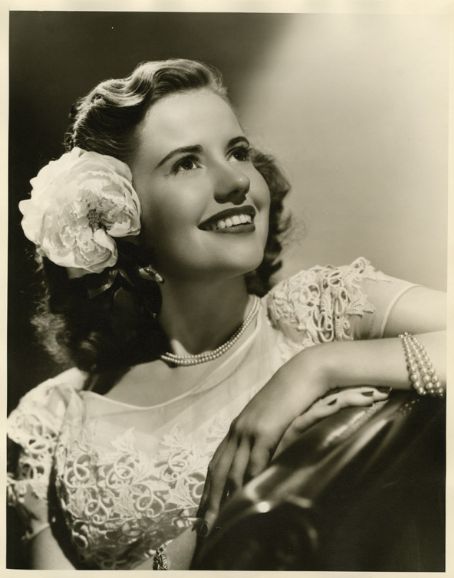
Janie is a charming wartime domestic comedy released by Warner Bros. at the height of the post-Normandy push in the autumn of 1944. After a successful run on Broadway, Jack Warner secured the project and assigned Michael Curtiz to direct newcomer Joyce Reynolds in the title role. Essentially an ensemble piece, it boasts a strong Hollywood cast (not a single Broadway holdover) featuring Robert Hutton, Edward Arnold, Ann Harding, Alan Hale, and Hattie McDaniel in key roles. Judging by the poster, the studio clearly marketed the film on the strength of the stage production, and as an effort to make a star out of the nineteen year-old Reynolds.

Here’s it is in a sentence or two: Janie Conway (Reynolds) is a small town girl whose hormones kick into overdrive when the army moves into her hometown of Hortonville, much to the consternation of her overbearing father (Arnold), who runs the local newspaper. Pretty soon Janie is juggling a newfound army beau (Hutton) and her high school sweetheart, both of whom want to knock the other’s block off. Everything wraps up Risky Business style, when the Janie and her girlfriends throw a big party for all the under-twenties from the army base at the Conway house.

In spite of the fact that this is a low-budget film targeted at teens, it has a great script and a particularly strong narrative construction, with numerous subplots that all wrap up nicely at the end. It embraces teen culture during, the generation gap, frustration with the bureaucracy of the war years, young love, old love, the marriage boom, self-sacrifice, and so forth — but manages to handle all of its subject matter with a good sense of humor. Curtiz’s direction is highly accomplished: he wrestles good performances from his young cast members, and allows the veterans to do their thing; the whole thing moves at breakneck speed, but the pacing of the comedic moments is perfectly handled and the film never loses its light touch — especially important in 1944.


With that in mind, it’s also important to note that while Janie has its sentimental, patriotic moments, it never feels heavy-handed or too much like rah-rah propaganda. Instead, the movie takes a more subtle approach, presenting a picture of the kind of idealized American family and Rockwellian small town life that the country’s young soldiers were supposed to be fighting for — whether it existed only on a Hollywood sound stage or not. It goes without saying that the characters are unrealistic — all the girls are pure as the driven snow, while the boys from the base couldn’t be more well mannered. Most of this will be irrelevant to viewers looking for a pleasantly diverting comedy film, which Janie certainly is — even more so than other, better known films. This thing qualifies as a forgotten gem.

Reynolds looks so much like Deanna Durbin that they could be sisters, and the whole movie has the feeling of a Durbin project. There’s even a musical number that happens during the party sequence, when all of the young people sing an impromptu rendition of Jules Styne and Sammy Cahn’s Keep Your Powder Dry (one year later the title of a Lana Turner picture). It’s an extended sequence that really swings; but while for me it was a highlight, the way in which everyone in the party takes a turn at the lyrics might damage the film’s sense of continuity for some viewers. And while Janie was a long-sought-after viewing for me (this is the only Academy Award nominee in the film editing category that I hadn’t seen), other who happen upon the movie are almost certain to enjoy it. It was successful enough that WB produced a 1946 sequel with Joan Leslie in the Reynolds part. Reynolds herself would only make three more films after Janie, two of them opposite Hutton, and would leave the business in 1950.  

Janie (1944)
Directed by Michael Curtiz
Starring Joyce Reynolds, Robert Hutton, Edward Arnold, and Ann Harding
Running time: 102 minutes
Released by Warner Bros. 

Wednesday, May 25, 2011

A Majority of One (1961)

My DVR recorded the hard to find 1961 film A Majority of One tonight on TCM, and I’m glad I won’t have to watch it — I was able to get a Warner Archive DVD copy via interlibrary loan earlier in the week and view it that way instead. This was my first experience with an “on demand” disc, and I found myself in agreement with the vast majority of people who champion the service. The transfer was crystal clear and the disc was pleasantly void of the innumerable obstacle screens that ruin most commercial DVDs. If free interlibrary loan wasn’t a perk of my teaching position I wouldn’t hesitate to purchase discs from this line.

There are two sticking points regarding A Majority of One that will dominate most discussions of the film and need to be gotten out of the way before any worthwhile assessment of the picture can happen. First is the casting of a Caucasian in the male lead. That master of disguises, Alec Guinness, plays Mr. Asano, a Japanese business magnate whose business dealings have attracted the attention of the US government. Realize going in that on a superficial level this is a romantic comedy about a widow and a widower from different cultures finding love in their golden years, but more importantly it’s about the healing of Japanese and American cultures in the wake of the war, interracial marriage and subsequent bigotry, with a little generational friction thrown in for good measure. My take on the casting of Guinness is this: Hollywood has always been in the money-making business, and I’m choosing to applaud them for broaching the subject in an A-list feature film, even if the producers elected not to cast an Asian performer in the male lead. If the film doesn’t get made without Guinness in the featured role, then I’m happy to accept it under those circumstances rather than not at all, knowing that Hollywood would eventually come around, one baby step at a time — though there’s really no reason why a Japanese actor couldn’t have been cast, other than the argument that Guinness’s star power would sell more tickets. One could argue that since the earlier Broadway production of the play (a big hit at 556 performances and multiple Tony nominations) starred Cedric Hardwicke in the role of Asano the precedent was already in place, but on the other hand James Shigeta and a primarily Asian cast was starring in Flower Drum Song at the same time over at Universal. And while I wince at Guinness’s performance a little (his idea of playing Japanese translates to a tilted back head and squinty eyes. He never once looks right.), the attempt at Japanese never strays into caricature — a flaw that greatly mars 1961’s most well-remembered film: Breakfast at Tiffany’s.

The second sticking point is A Majority of One’s rather gaudy running time of two-and-a-half hours. Considering the film is essentially comedic, with a sprinkling of dramatic moments that anticipate the flavor of many films from the 1980s, it’s difficult to stay engaged and light in heart for 150 minutes of movie. Although this is understandable when we realize the director / producer was Mervyn LeRoy, who could make a long picture as well as a short one, the exhibition cut of A Majority of One could have easily gone back to the cutting room and lost fifteen minutes of unnecessary footage. Nevertheless, there’s enough good stuff here that anyone considering the viewing film should plow ahead without reservation.

At the top of the heap of all that good stuff is the extraordinary Rosalind Russell, who stars as Mrs. Jacoby, the Jewish mother from Brooklyn who comes to adore her new Japanese friend, despite having lost her only son in the Pacific war. Russell, one of the most extraordinary — and despite the great deal of acclaim she enjoyed, underrated — actresses of her era, simply shines here. She’s the glue that holds this long picture together. Her chemistry and interactions with her each and every one of her fellow performers is different in character yet perfect in tone. Her performance is nuanced by confidence, timing, and restraint — and her accent would make Meryl Streep proud. Despite the fact that Russell, even at 54, was busy juggling film, TV, and theatrical projects, it’s clear that she gave herself away to this one. It’s as good a performance as you’ll find in any film from the period, yet one that despite its brilliance was snubbed by Oscar — A Majority of One’s sole nomination came in the Color Cinematography category. Regardless of Oscar’s mild drubbing of Russell (four nominations, zero wins. Hersholt Humanitarian Award in 1973, three years before her death.), the Globes simply adored her. She would win Best Actress Musical/Comedy for this film, and then again the next year for her work in LeRoy’s next project, Gypsy. She had previously won in the Musical/Comedy category in 1958 for her signature performance in Auntie Mame, and in the Best Motion Picture Actress category (the Academy equivalent) in 1947 and 1948 for Sister Kenny and Mourning Becomes Electra, respectively. If you can catch Roz as a nurse in Kenny on TCM do so, but I’m on the record with Electra as one of the strangest classic period films out there — it isn’t for everyone and it isn’t the Roz most people know and love. There are many victims of Oscar snubbings, but with five Golden Globes and no Oscars, Russell has to be at the top of the list.

Performances aside, the film’s themes of forgiveness in the wake of the war and of interracial love may date it with younger viewers, but the script is rich enough to remain interesting and the dialog certainly entertains. Granted the film is overlong, there’s enough here to warrant a viewing. My one qualm: Mrs. Jacoby warms to Mr. Asano far too quickly — through just a single scene early in the picture — and LeRoy misses the opportunity for dramatic fireworks between his two stars, especially when both were as adept with drama as they were with comedy. The scene in which the pair meet on the deck of an ocean liner deftly blends dramatic tension with physical comedy — the movie sells out for affability when a great deal more character development was possible.


A Majority of One (1961)
Directed by Mervyn LeRoy
Starring Rosalind Russell, Alec Guinness, and Ray Danton
Released by Warner Brothers
Running time: 150 minutes
Availability: Warner Brothers Archive DVD, TCM.

Tuesday, June 1, 2010

Dive Bomber (1941)

Fred MacMurray and Errol Flynn have strong chemistry together in director Michael Curtiz’ big budget aviation film. I’ve never been a big Flynn fan, but this film helped my opinion of him — he’s certainly more believable here than in a film such as Objective, Burma!, where we are supposed to buy him as a hardened infantry commander. Freddie Mac is as reliable as ever, and Bellamy is fine in a serious role. It's actually nice to see him cast as something other than the boob in a romantic comedy for once.

It may not be accurate to call this a WWII film as it was produced and released during the buildup of 1941, but looking back it functions as one. The film is formulaic in its approach: MacMurray plays a salty flight commander to Flynn's pretty boy M.D. When MacMurray's best friend is killed in a crash, he blames Flynn for the man's operating table death. Flynn keeps his cool and turns his guilt into resolve to do something about the high-altitude blackouts that are really to blame. He transfers into the flight surgeon's unit and draws Freddie Mac as his flying instructor. Of course MacMurray and his pals give Flynn a miserable time, but he eventually wins them over through the progress he's able to make alongside fellow doctor Ralph Bellamy.

Dive Bomber is entertaining, but overlong at two + hours by at least 30 minutes. There are some incongruous and unnecessary comedy bits and even an out-of-place romantic angle with Alexis Smith. What this does have going for it are some spectacular aviation scenes filmed in technicolor. The movie scored Oscar nominations in visual effects and cinematography, both of which were well deserved. Dive Bomber is clearly a cut above other early-war flight films, if not in story then clearly in cinematography. There are numerous scenes are formation flying that are impressively stirring.

Dive Bomber (1941)
Grade: B-
Directed by: Michael Curtiz
Starring: Fred MacMurray and Errol Flynn
Released by Warner Brothers
Running time: 132 minutes
Availability: DVD